13 February, 1943
Handley Page Halifax B Mk II (W7885 code TL-B)
Landeleau, " Leing-ar-Menez " (29)
(contributors : Philippe Laroyenne, Daniel Dahiot, Philippe Dufrasne, Sandra Tizzard, Rob Vogels, International Bomber Command Centre, France Crashes 39-45)
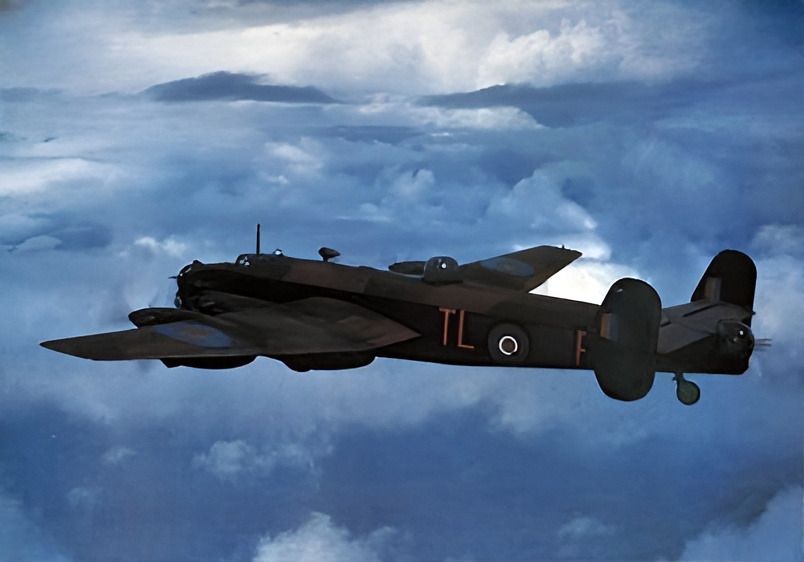
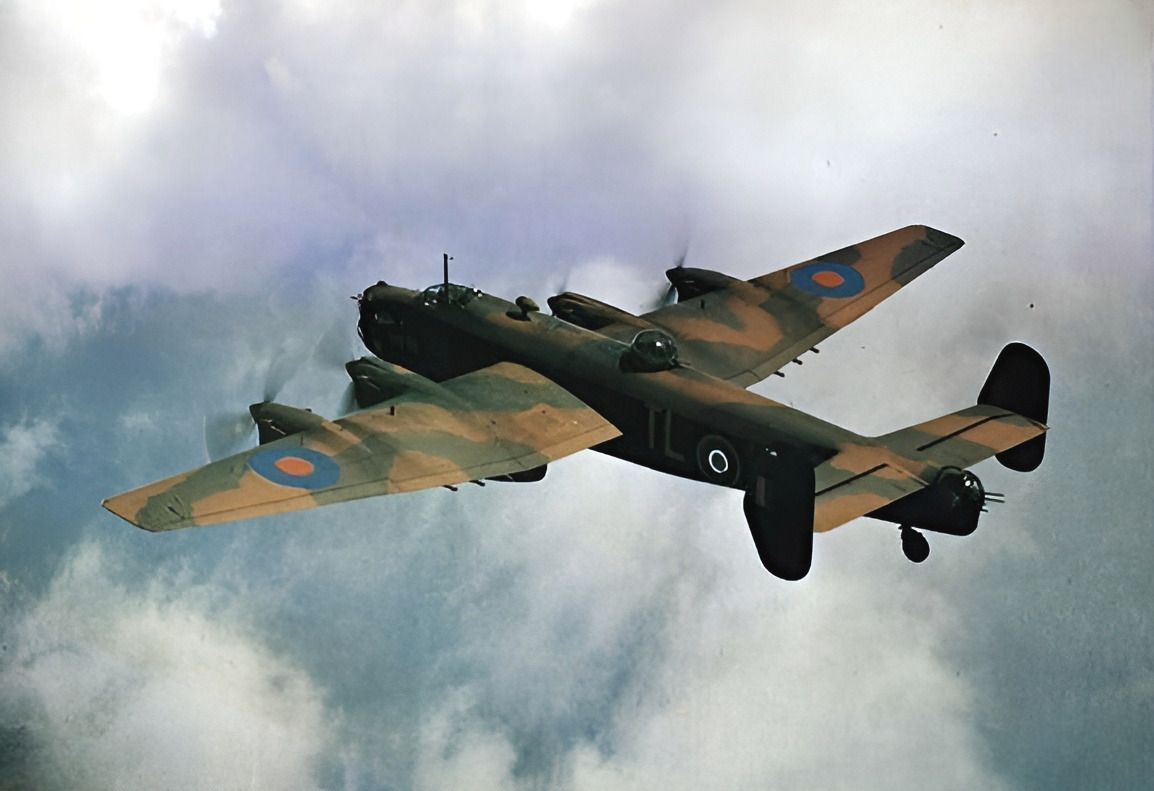
Handley Page Halifax Mark II " TL-P " No. 35 Squadron
“Halifax BII,” collection Thomas, Arthur Froude (Album 4) - IBCC Digital Archive, link.
Crew (No 35 Squadron) :
- Flying Officer (pilot) James Copeland THOMAS (RCAF, service number J/10162 or J8390), escaped.
Narrowly escaped arrest and reached Switzerland with the help of railway workers. Remained there until August 1944.
- Sergeant (bombardier) Richard MARTIN (RAF, service number 1076885), escaped.
Born on August 6, 1914, in St Annes-on-the-Sea, Lancashire, England.
Escaped with the help of the Pat O'Leary network via the Pyrenees, Spain, and Gibraltar.
Returned to England on July 24, 1943.
- Flying Officer (navigator) Gordon Henry François CARTER (RCAF, service number J/11213), escaped.
Born on June 1st, 1923, Bronxville, New-York (USA).
Escaped with the help of the Pat O'Leary network on the fishing boat Dalc'h Mad in April 1943.
Returned to England on April 9, 1943.
- Sergeant (engineer) Daniel Christie YOUNG (RAF, service number 979344), POW.
Captured on March 3, 1943. Prisoner No. 1166, Stalag Luft I/VII/IV/XI-B.
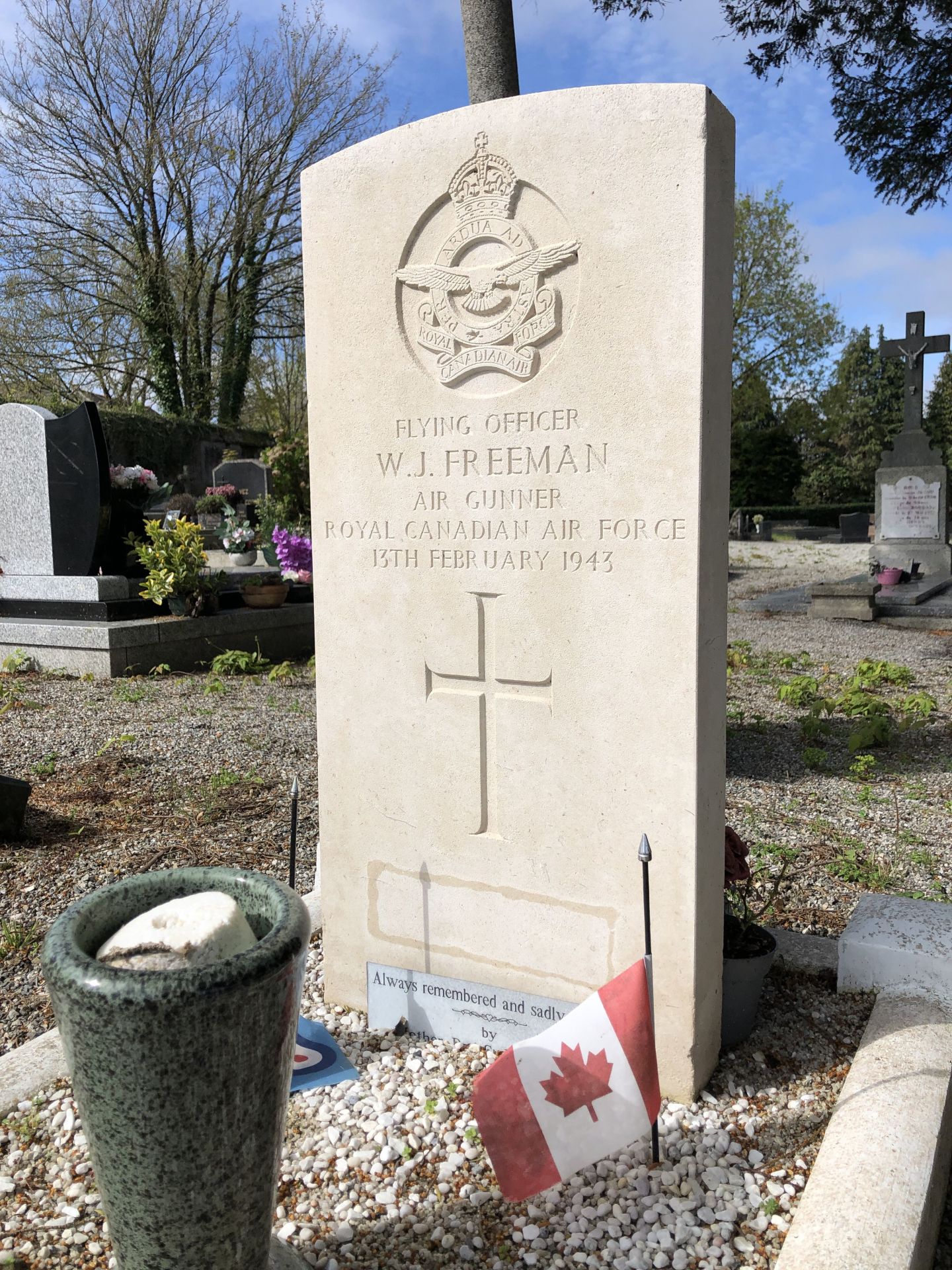
- Flying Officer (gunner) William Joseph " Bill " FREEMAN (RCAF, service number J/10162), 21 years old, killed.
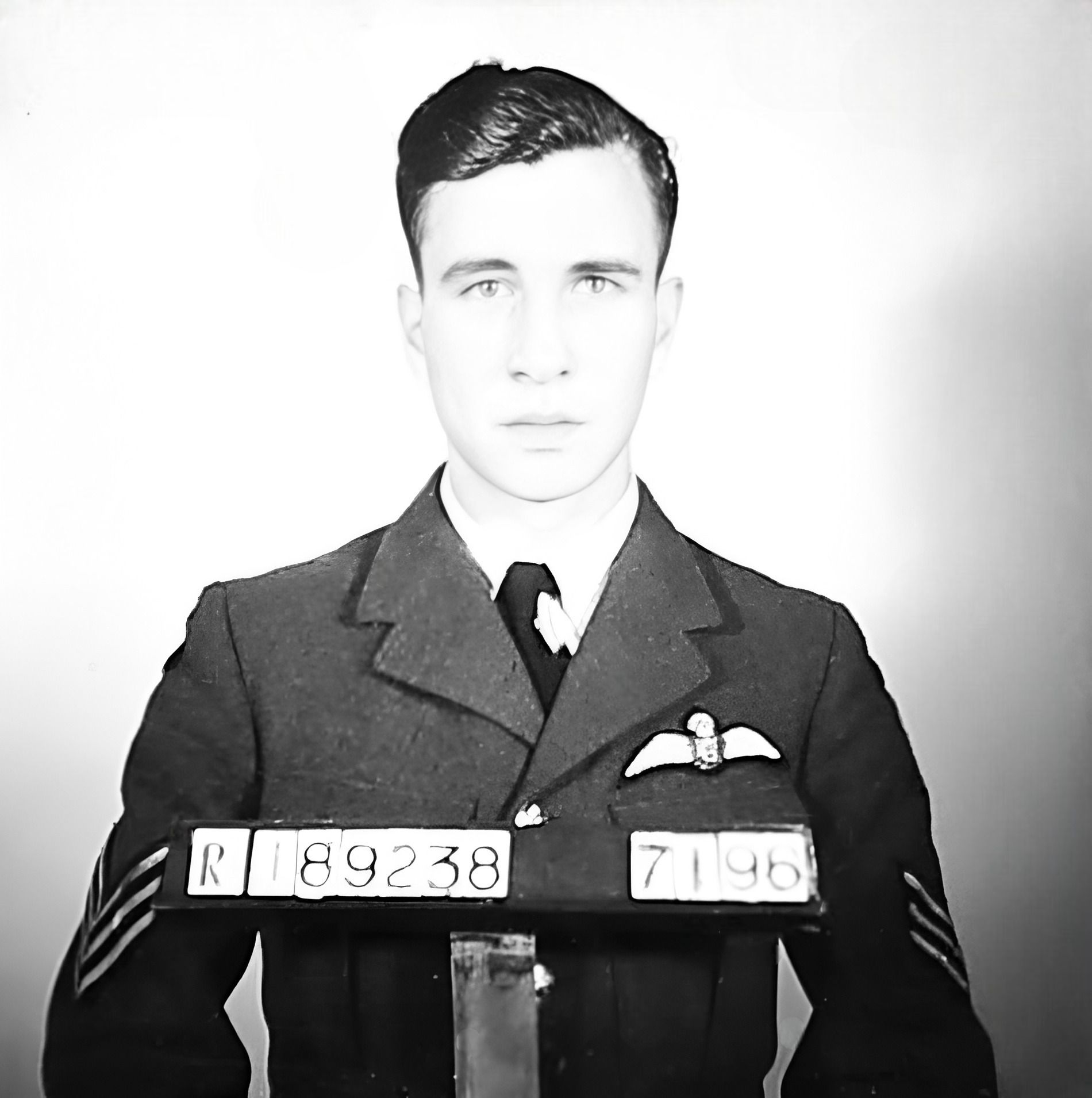
Photo Sandra Tizzard via Findagrave.com
Clinging to the tail of the aircraft by his parachute, he crashed with the plane and died 20 minutes later.
Born on September 29, 1921 in Newman, Bonner, Idaho (USA).
Carhaix Municipal Cemetery (29).
- Sergeant (radio-operator - gunner) Edward Roland TURENNE (RCAF, service number R/86205), escaped.
Born on March 1st, 1915, Saint-Boniface, Manitoba (Canada).
Escaped with the help of the Pat O'Leary network via the Pyrenees, Spain, and Gibraltar.
Returned to England on July 24, 1943.
- Sergeant (gunner) John Napoleon BARRY (RCAF, service number R/135217), escaped.
Born on July 20, 1918, in Montreal, Quebec (Canada).
Escaped with the help of the Pat O'Leary network via the Pyrenees, Spain, and Gibraltar.
Returned to England on July 14, 1943.
THE STORY
On February 13, 1943, 8 Halifax bombers from No. 35 Squadron were designated to attack the Lorient submarine base (56). But only six aircraft took off between 6:14 pm and 6:23 pm from RAF Graveley, Huntingdon, Cambridgeshire, England. Halifax W7885, coded TL-B, was hit by flak over the target, and the crew abandoned the aircraft around 8:45 pm. Tragically, one of the crew members, Flying Officer Freeman (gunner), remained clinging to the tail of the aircraft and was killed when the aircraft crashed.
♦ ESCAPE REPORTS FROM THE SURVIVING CREW MEMBERS
(source France Crashes 39-45).
- Sergeant John Napoleon BARRY :
(WO 208/3314/1299)
My account is the same as that of F/O Carter and is quoted in his report.
Appendix C - While F/O Carter and I were staying at St-Méen (56), Mr Guy Dubreuil* gave us 3,000 francs each. On 21 March 1943, I went to Miss Madeleine Marchaix's* house, a nurse, living at 14 " Place de l’Église " (church square), in Carhaix, where I stayed until 6 May. It was during this period that I met Val, known as Guillaume, who told me that he would arrange for us to cross into Spain.
On 6 May, Val took us by train to La Pie (22), and from there, via Rostrenen, to Saint-Brieuc. At Saint-Brieuc, we took the tram to Étables, where I stayed with Val’s radio operator. While I was there, Val gave me a new identity card. As the boat that was supposed to evacuate us failed to arrive, Georges Jouanjean* (he would be arrested in May 1944 and deported to Auschwitz – No. 53656), a guide and I decided to leave Étables because we did not think we could remain there safely. We took a train to Plouézec, 12 miles north-west of Étables, where I contacted a Dr Meynard (address unknown) and told him our story. He said that he could not help us himself but would put us in touch with someone who could. He took us to see the Countess de Mauduit* at the " Château de Bourg Blanc " (Castle of Bourg Blanc), Plourivo. She was an Englishwoman who had spent most of her life in America. We told her that we had left the rest of the group, including several Americans, at Étables, and she said that she would like to meet the Americans. Accordingly, Mr Jouanjean, whom we called " Joe ", and I drove her back to Étables. That night, I returned to Plouézec and slept in a hotel. The following day, 8 May, I went back to Plourivo, about 12 km from Étables.
Later that day, " Joe " arrived at the " Château de Bourg Blanc " with about ten other members of the group. The only names I can remember were Fitzgerald, Robertson, Marshall and Jack Luehrs, who were Americans, F/Sgts James and Smith, and Sgts Hall and Groves, all of the RAF. On 27 May, F/Sgt Turenne, a member of my crew (now in Gibraltar), arrived at the château. Accompanied by " Joe ", the three of us went to Paimpol. From there, we took a train to Guingamp and then an express train to Paris. While we were staying with the Countess de Mauduit, we were visited almost daily by Mrs Jeanine Guilaind (actually Jeanne Guilaine)* and Mrs Corgau, both of whom lived in Paimpol. They brought us food.
We arrived in Paris on 28 May, and I went to Elisabeth [Campbell]’s* apartment at 72 rue Vaneau. That same afternoon, I went to Austerlitz railway station, where I was to meet someone who was to be taken to Pau. There was a check at the main entrance, so we went to the rear of the station, where a railway employee had left a gate open. We arrived in Dax (40) at about 10 pm and caught a connecting train to Pau. At Orthez (64), identity cards were subjected to a very thorough inspection. I was travelling under the name Dubarry and was supposed to be a woodcarver. In Pau, we were taken to a hotel, where we rested for a while. On 31 May, we set off to cross the Pyrenees. By this time, there were about thirty of us in the group. The crossing was extremely difficult, as we had only one day’s rations for a journey that lasted three days.
On 3 June, at Isaba, we were arrested by the Spanish Civil Guard and taken to a local prison. The remainder of my account is as described in Appendix " C " to the report by S/Ldr Lefèvre [pilot of the Spitfire Mk VI of No. 616 Squadron, shot down on 16 April 1943 at Plouguin (29), north-west of Brest].
- Sergeants Edward Roland TURENNE and Richard MARTIN :
(summary of reports WO 208/3314/1314 and WO 208/3314/1315)
Sgt Turenne landed in a field near Spézet (29). Shortly afterwards, he was helped by Jean Canevet* in Spézet, where he was provided with food, civilian clothing and accommodation. On the 14th, he was taken to a house in Châteauneuf-du-Faou, where he rejoined Sgt Martin, who had landed near the bank of a canal. They were subsequently joined by Sgt Young, who had a sprained ankle, and finally by F/O Thomas.
They were accommodated in the Carhaix area by Mr Georges Jouanjean*, Mr Lebec* and Miss Correc* until the 17th, when the group was taken by train to Paris, to Armand Leveque*’s family. Thomas stayed with Mr Leveque, Martin went to stay with Mrs Anne Lescure*, and Turenne with Gaston Maillard*.
On 9 March, the Gestapo went to Mr Leveque’s house, where only his wife was present. She would subsequently be arrested and deported. Sgt Young had just enough time to jump out of a window and escape capture. The same day, the Gestapo raided Mr Maillard’s house, from which Sgt Turenne managed to escape. Martin and Turenne were then sent to Maule, to stay with Mr Jutteau*.
On 20 March, Martin returned to Paris and stayed with Emile Bollinger* until the 31st, then with Henri Auble until 10 April, followed by a one-day stay with Countess Hélène de Suzannet*. On 23 April, using new identities, Martin and Turenne took the train to Saint-Brieuc (22), then travelled to Étables-sur-Mer, where they stayed with Jean Camard*. As the evacuation plan had failed, Martin returned to Paris on 12 May and stayed with Mr Demongodin* in Asnières until the 26th. He then moved in with Mrs Wiame*, where he was joined by Sgt Bulman (an observer in a Halifax shot down on 12 March 1943 at Mondrepuis, in the Aisne department). On the 28th, Martin took the train to Pau with thirteen other evaders, intending to reach Gibraltar. Turenne did not return to Paris. On 25 April, he went to Brest with Jean Tromelin* and then to Saint-Nic, but without success. They returned to Étables to stay with Mr Camard, then went to Saint-Quay and subsequently to the Château de Bourg Blanc, where Countess Roberta de Mauduit was sheltering them at Plourivo (22). Barry was also there. Finally, Turenne and Barry returned to Paris to make their way to Gibraltar.
- Flying Officer Gordon Henry François CARTER
(summary of report WO 208/3312/1155)
Immediately after landing, he was taken to a house in Kerlescoat, in the town of Spézet, where he rejoined Sgt Barry. They spent the night there and then made their way towards Pont-Rouge, west of Priziac (Morbihan), via Gourin, spending the night at a farm. The following day, 15 February, they walked to Guémené-sur-Scorff and took a bus to Pontivy. When they arrived, they were approached in a café by a man named Mr Pierre, who showed them an RAF button and told them that F/O Thomas was already in the hands of an organisation receiving arms and ammunition. He took them to the home of Guy Dubreuil at St-Méen, where they stayed until 8 March, posing as refugees from Lorient. Then, they went to Ploërmel, where the town hall secretary provided them with identity cards and clothing and footwear coupons.
They were joined by an American, Clairborne Wilson (an engineer in the B-17 serial no. 42-5717, which crashed at La Ville Dan, in the commune of Guillac (Morbihan), on 16 February 1943). He had been taken in by a farmer near Josselin (Morbihan). Together with Dubreuil, they travelled by taxi to Plouégat (29), then walked to Morlaix and took a train to Saint-Pol-de-Léon. They spent the night at the Hôtel des Voyageurs.
Following a message broadcast by the BBC, they went to a beach north-east of Bougourouan. However, as the boat failed to arrive, they returned to Saint-Pol. Three days later, having received no further instructions from the BBC, they returned to Pontivy by train. Two members of the organisation, the Chief of Police and Henri Clément*, took charge of them and escorted them to Notre-Dame de Timadeuc Abbey, near Bréhan (Morbihan), where they stayed for three days. Then they left for La Pie, near Carhaix-Plouguer, accompanied by Georges Jouanjean (" Joe ") and an American, Robert Biggs (co-pilot of B-17 serial no. 42-5378, which crashed at Ploemeur (Morbihan) on 6 March 1943). On 19 March, they took the train to Morlaix and then travelled to Paris, to Mr Leveque’s home, but the Gestapo was there. On the 20th, they took the train back towards Brittany. Carter was accommodated by Raymond Cougard* in Gourin for two weeks.
On 5 April, Joe took Carter to Douarnenez (29), accompanied by two Frenchmen. They spent the night in Claude Hernandez's* house. On the 6th, Carter was taken in charge by Louis Marec*, skipper of the fishing boat Dalc’h Mad. They were due to meet fourteen other Frenchmen. The fare was 4,000 francs per person, and Carter’s share was paid by Abbé Cariou* of Plogonnec. They left the port of Tréboul at 8:45 am on 7 April. Five men stood on deck dressed as fishermen, while the others were hidden in the hold. The skipper told the German customs officer that he was heading for Douarnenez. On arrival, another customs officer challenged them, but Claude Hernandez created a diversion by claiming that a sheet had been stolen from his car. The skipper took advantage of the distraction to put out to sea. The boat arrived at Penzance, a seaside resort and port in the Penwith district of south-west Cornwall, on 9 April 1943.
Another document from archives records the following : " On 9 April 1943, at 10:00 am, a French fishing boat arrived from the Lizard Point, and a man came ashore stating that he was F/O Gordon Henry Francis Carter of the RAF. He stated that he had been shot down during a bombing raid on Lorient, France, on the night of 13 February 1943, and that he had escaped with the other occupants of the fishing boat. He was detained in custody pending enquiries. The boat arrived at Penzance with 18 occupants, all of whom were male. ”
* All these people were listed as " helpers " by the Americans at the end of the war (see appendices).
♦ SUMMARY OF LOSS REPORT K.20
(source : The National Archives via France Crashes 39-45).
The Halifax was hit by flak in several places shortly before reaching the target. There was a large hole in the nose plexiglass on the port side. The Type 35 camera and the bomber’s intercom system were destroyed, and there was also a large hole in the fuselage at the upper turret. The bombing run was completed, and the pilot altered course to drop flares and T.I. markers. After these had been released, the rear gunner reported that the port outer engine was on fire. The propeller was feathered and the gas supply cut off. The Graviner fire extinguisher was then activated, but without success. A dive of 4,000 feet had no effect, and the flames spread into the interior of the aircraft. The pilot then ordered the crew to bail out. All the crew members managed to parachute to safety, with the exception of the rear gunner, who was found beside the wreckage. It is possible that his parachute had become entangled with the aircraft. The pilot had some difficulty getting out of the aircraft, as his parachute caught on the side of the escape hatch. The flight engineer had to pull his parachute out of its pack by hand because the automatic deployment mechanism failed to operate. He sprained his ankle on landing. The gunner, Sgt Barry, landed on a hillside and lost consciousness on impact.
IN MEMORIAM
♦ Grave of William Joseph Freeman, Carhaix municipal cemetery (Finistere, Brittany).
(source : Rob Vogels via Findagrave.com)
APPENDICES
♦ Operational Record Book of Squadron No. 35 for the date of February 13, 1943 (AIR-27-380-3_page 2)
(source : The National Archives)
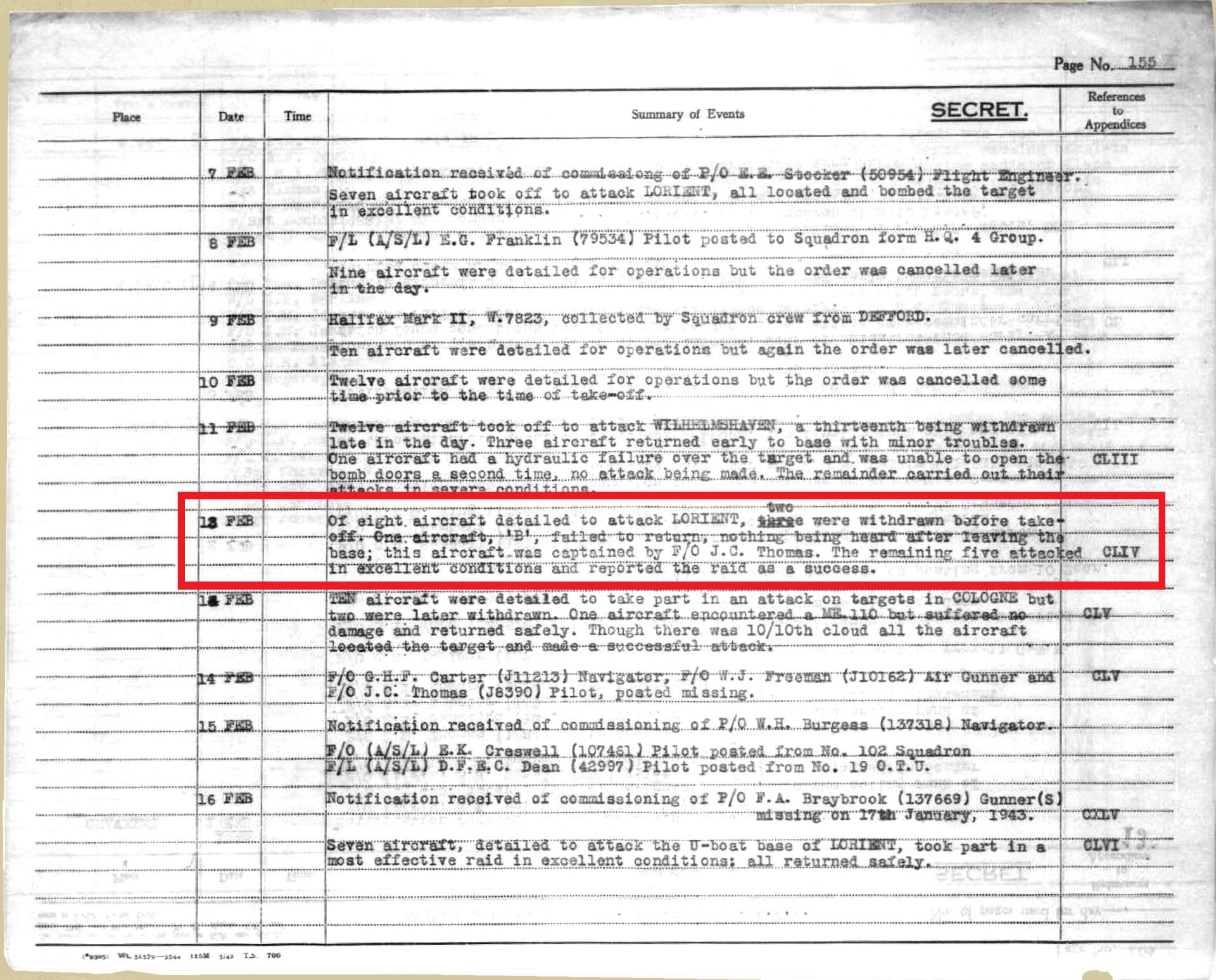
This document reveals that out of the eight aircraft initially planned for the mission, two were withdrawn before takeoff.
It also states that the Halifax coded " B " failed to return, did not communicate after takeoff, and was commanded by
Flying Officer J.C. Thomas. The five remaining aircraft attacked the target successfully and declared the raid a success.
♦ Operational Record Book of Squadron No. 35 for the date of February 13, 1943 (AIR-27-380-4_pages 11 &12)
(source : The National Archives)
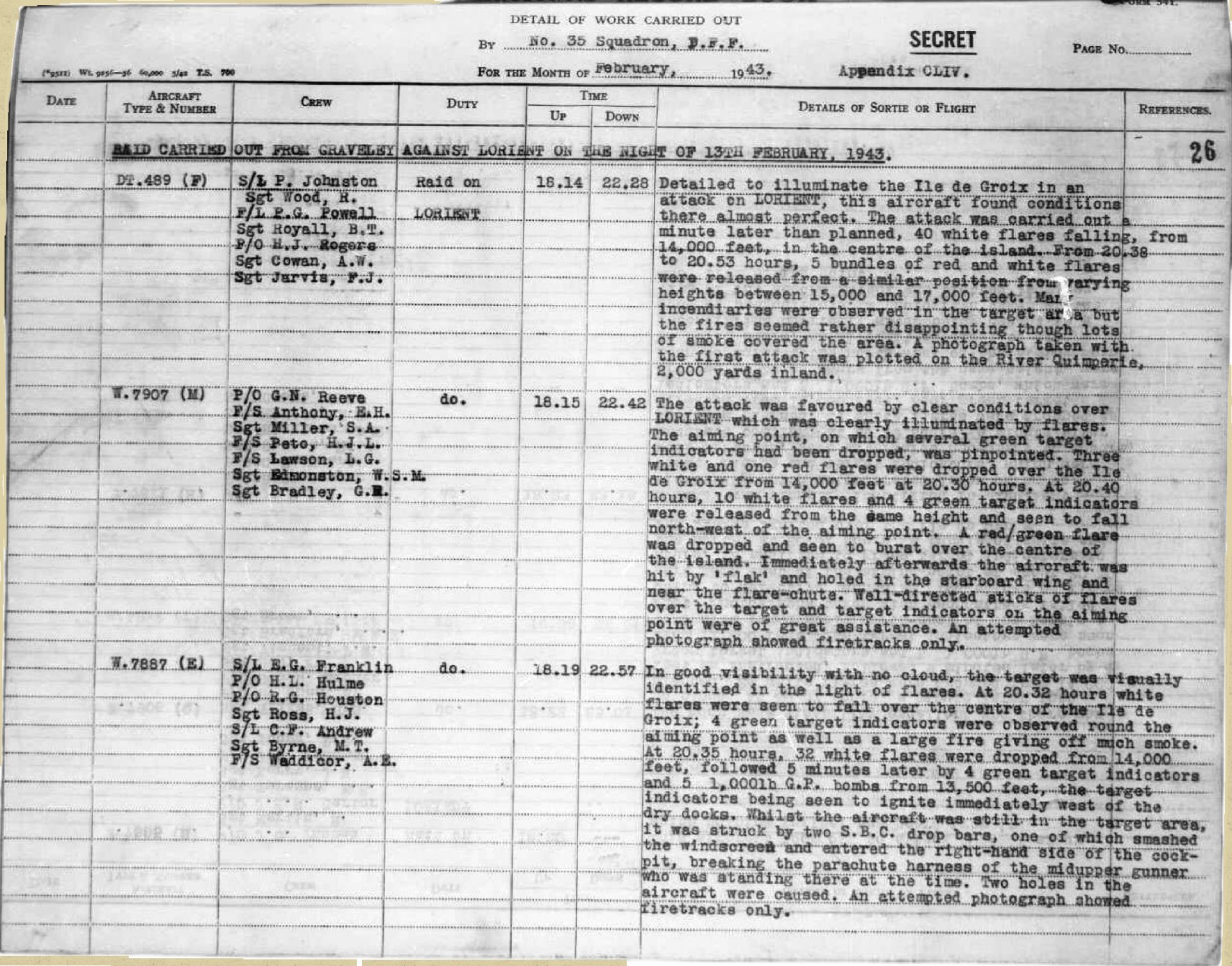
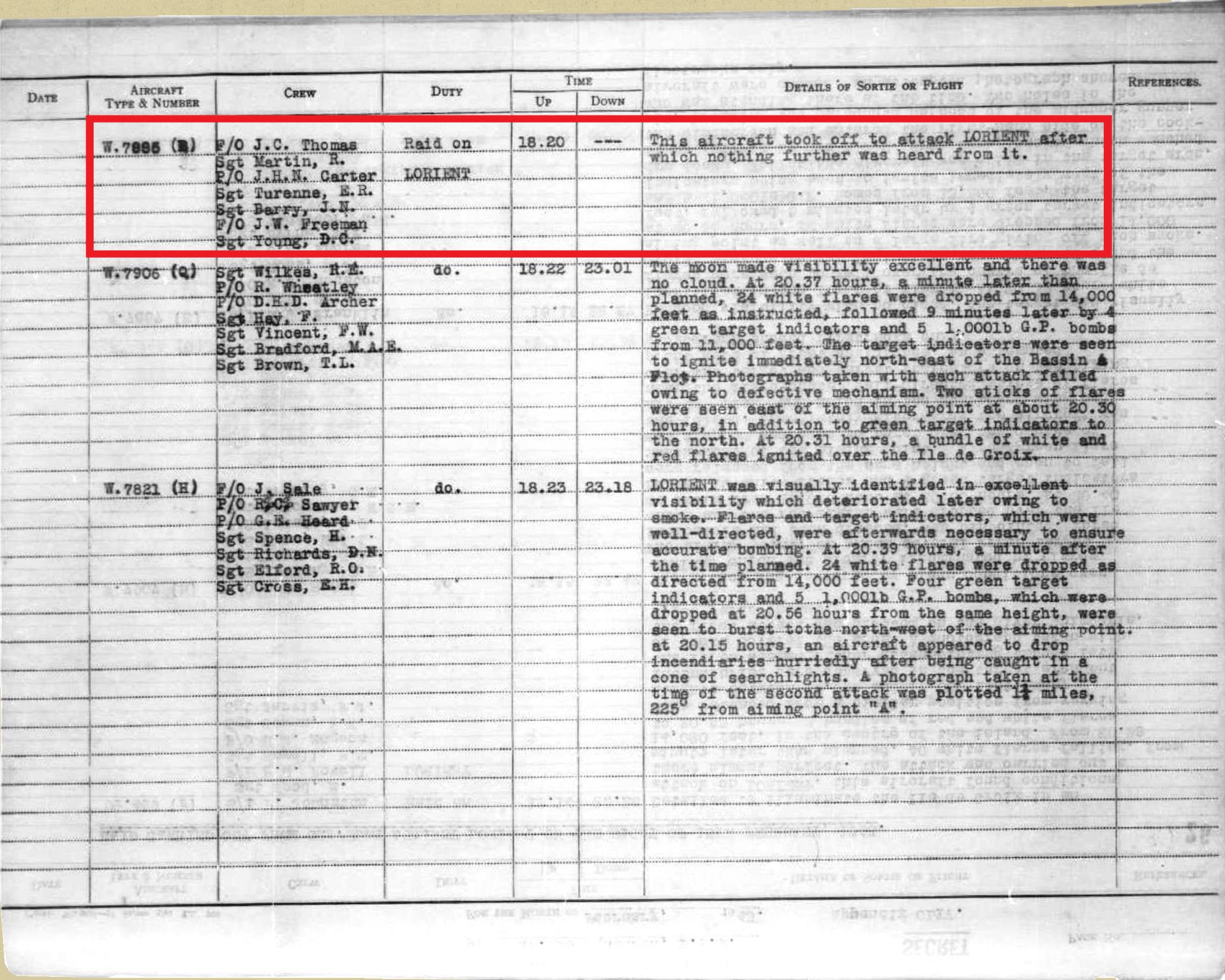
This document, which lists the crews for the mission of February 13, 1943, reveals that the Halifax TL-B took off at 6:20 PM
to attack the Lorient submarine base and that no further messages were heard afterward.
♦ List of " helpers " who contributed to the rescue of the aircraft crew.
These people have files in the archives in Washington, D.C., USA.

Mr. Guy Dubreuil, from Saint-Meen in nearby Morbihan, was listed but apparently the information was not traced.

The spelling of Miss Marchaix remains to be determined (Marchaix or Marchais?).

Georges Jouanjean was deported for helping airmen. He was awarded the British Empire Medal and his family received 50,000 francs.

Countess " Roberta Betty de Mauduit " was deported to Ravensbrück but survived. She received 60,000 francs for her courage and was decorated,
among other things, with the King's Medal for Courage (note the KMC stamped over KMS, which stands for King's Medal for Service).

Jeanne Guilaine was listed at the same address as the " Countess de Mauduit " when she lived in Paimpol.
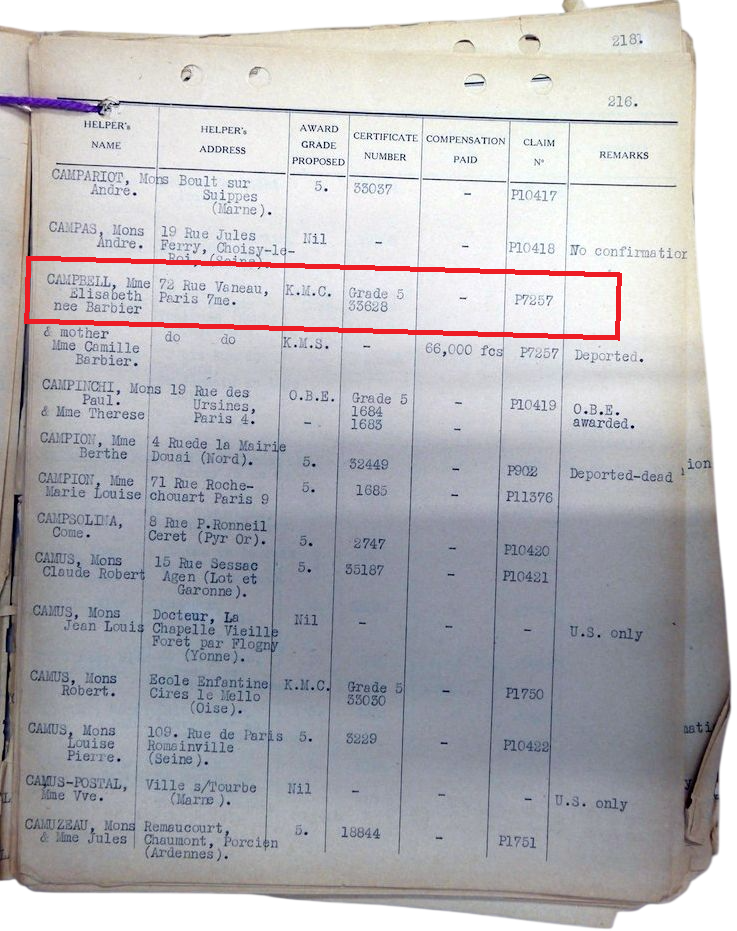
Elisabeth Barbier Campbell's record.

Jean Canevet's record.
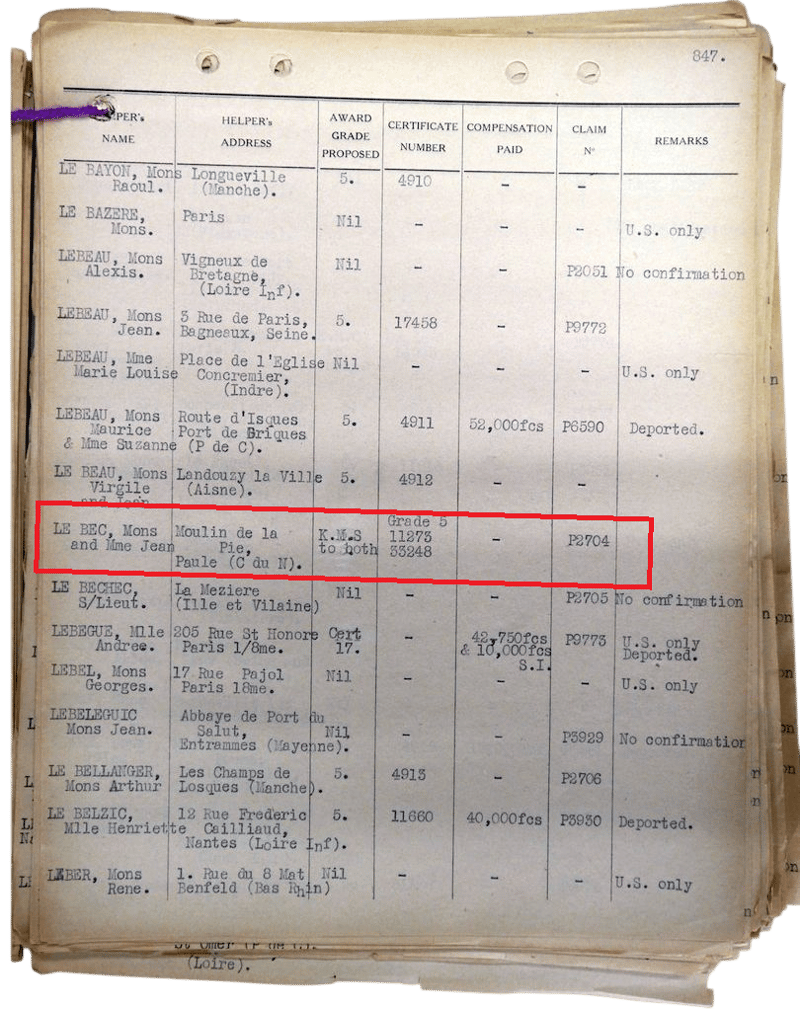
Jean Le Bec and his wife were awarded the King's Medal for Service..
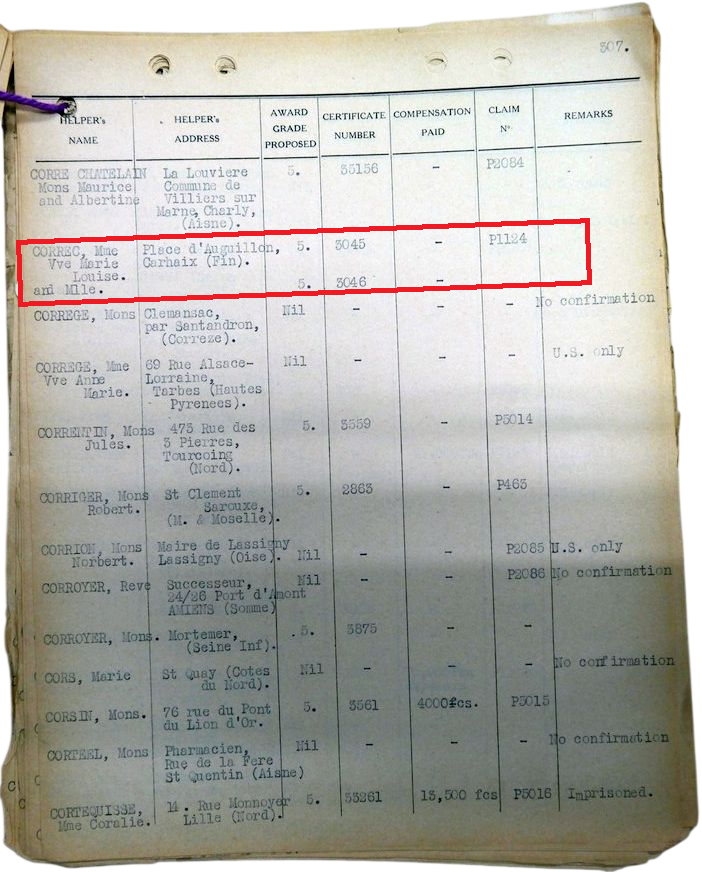
Miss Correc's record (and her mother Marie-Louise, widow).

This document reveals that, unfortunately, the Leveque family was deported and that Armand Leveque died. For his sacrifice, he received
a " Certificate 17 " from Great Britain, while his widow Marcelle and his daughter Andrée both received the King's Medal for Courage.
In addition, 360,000 francs were paid to the widow (presumably for the loss of her husband), as well as 27,000 francs
and 23,000 francs to Andrée Leveque.
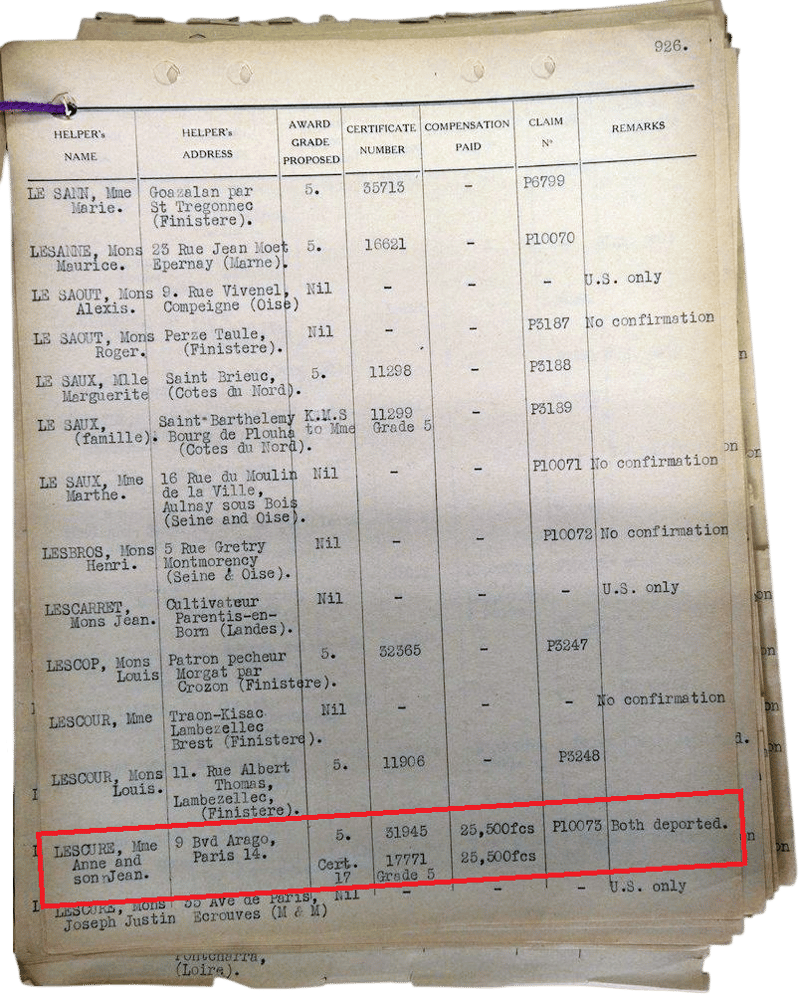
Anne Lescure and her son Jean were both deported. They were rewarded with a " Certificate 17 " and 25,500 francs were paid to each of them.
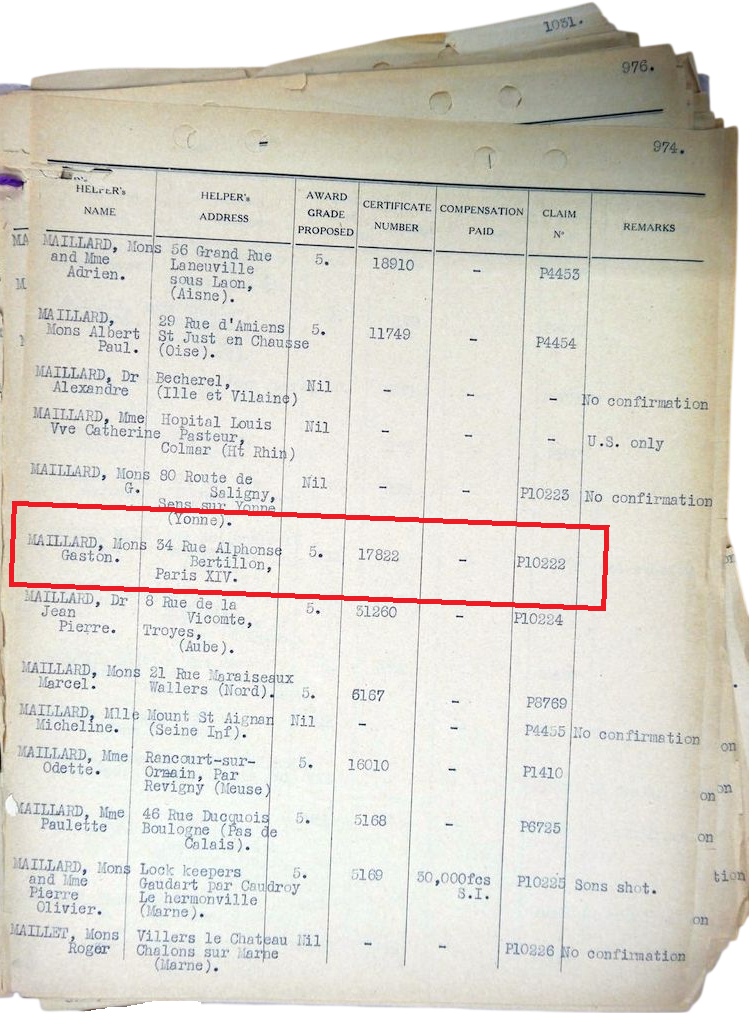
Gaston Maillard's record.

Lucien Jutteau's record.

Emile Bollinger's record.

The Countess " de Suzannet " received a Certificate 17 from the United Kingdom.

Jean Camard and his wife Josephine were both awarded the King's Medal for Service, and received 25,000 francs and clothing.

Lucien Demongodin received 6,000 francs in compensation for the expenses he made for the aviators.

Mrs Gabrielle Wiame was recognized as a Member of the Order of the British Empire (MBE)
and received 60,000 francs in compensation for expenses made in helping the airmen.

Jean Tromelin and his son Janic were awarded the King's Medal for Service.
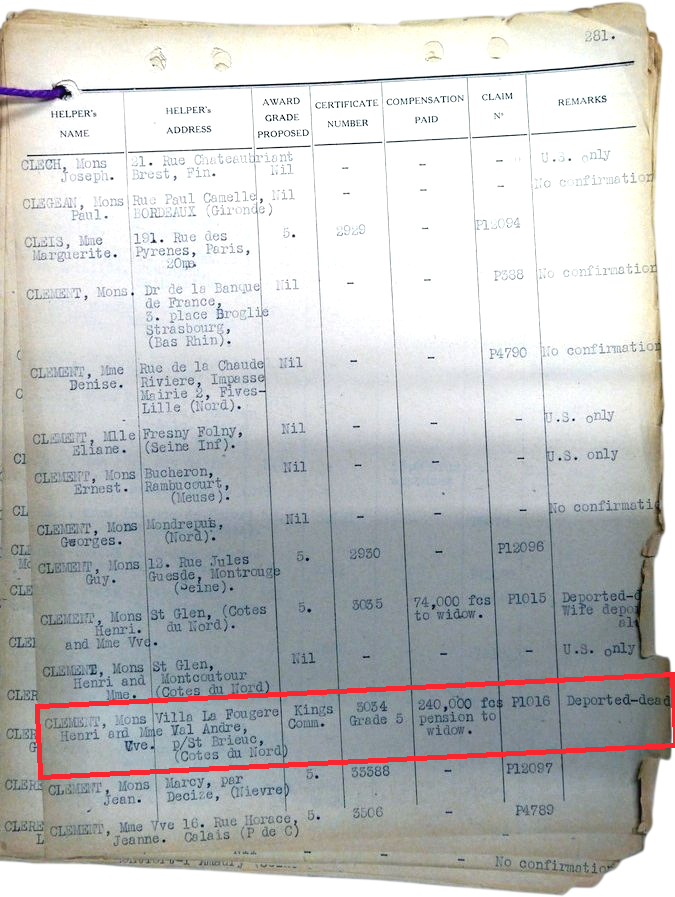
This document informs us that Henri Clément was deported and died in deportation. He received a King's Commendation for Brave Conduct,
and his widow received 240,000 francs.
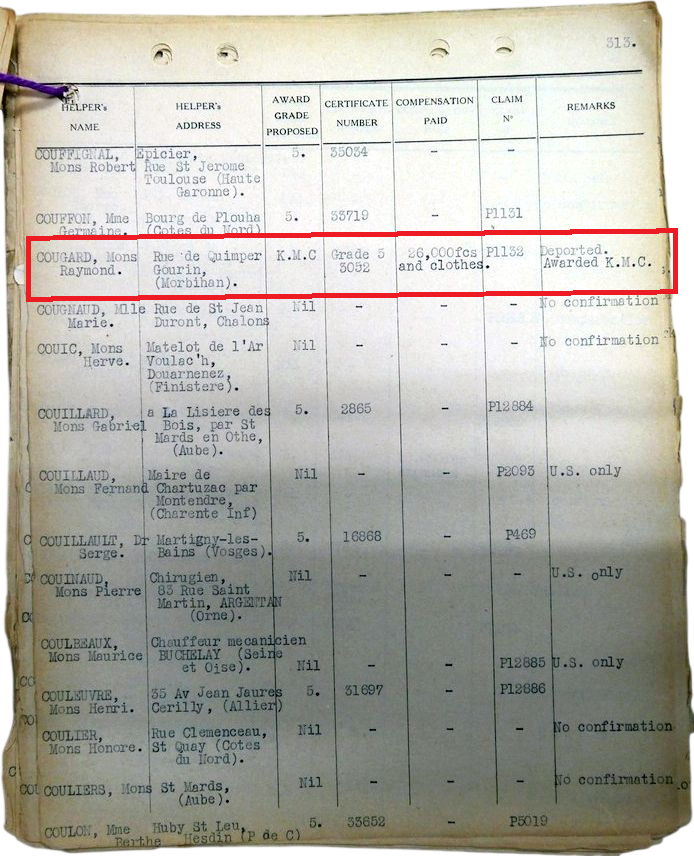
Raymond Cougard was deported and received the King's Medal for Courage from Great Britain. In addition, he received 26,000 francs.
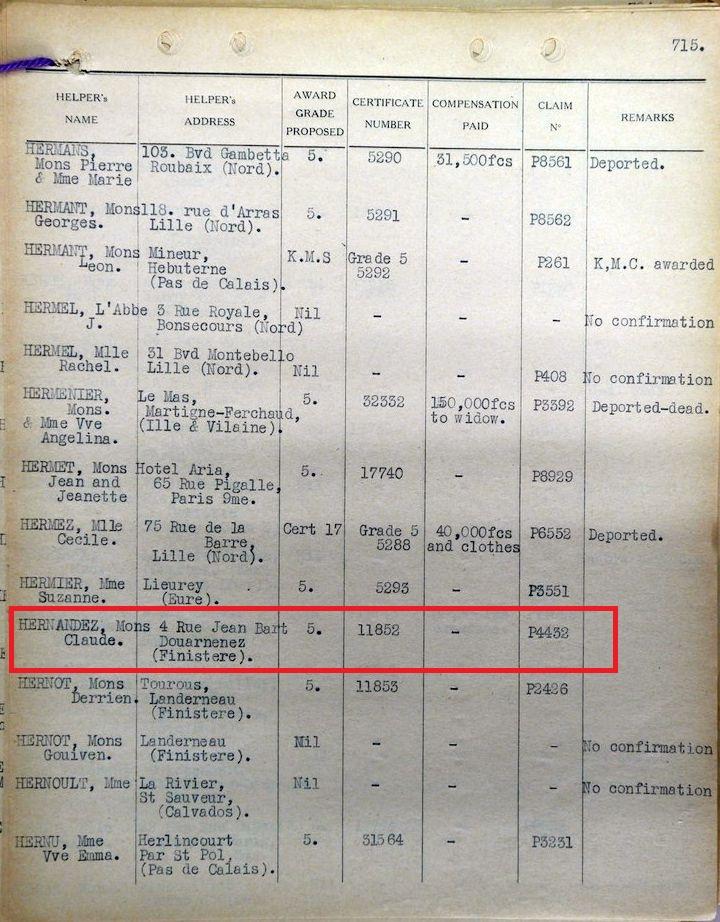
Claude Hernandez's record.
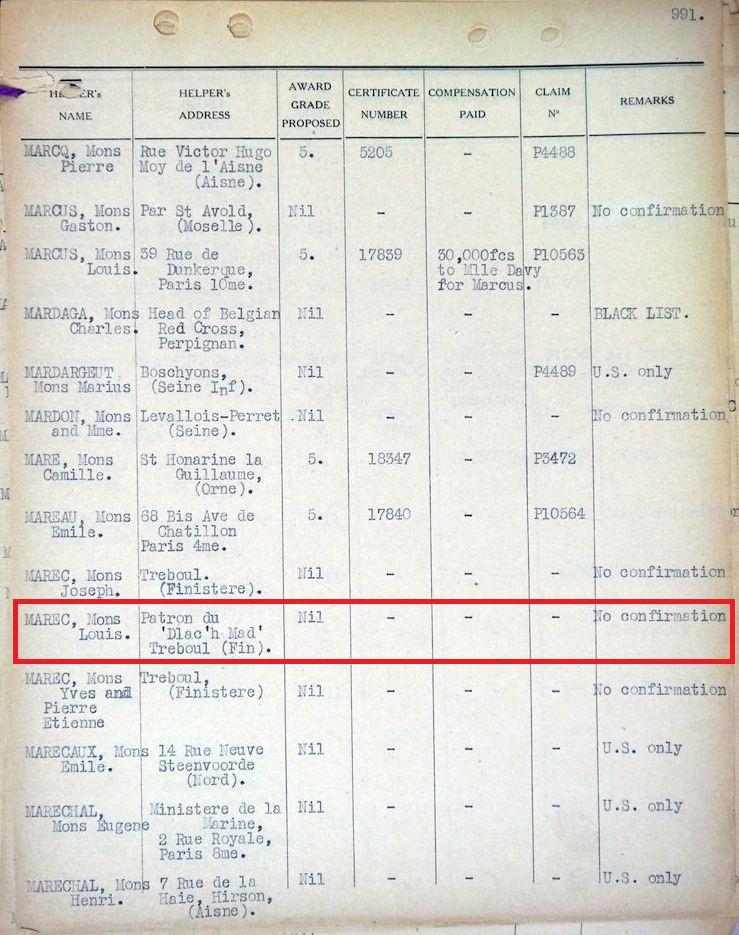
Louis Marec's record (skipper of the fishing bopat Dalc'h Mad).

Abbé Cariou's record (spelled here with an s).
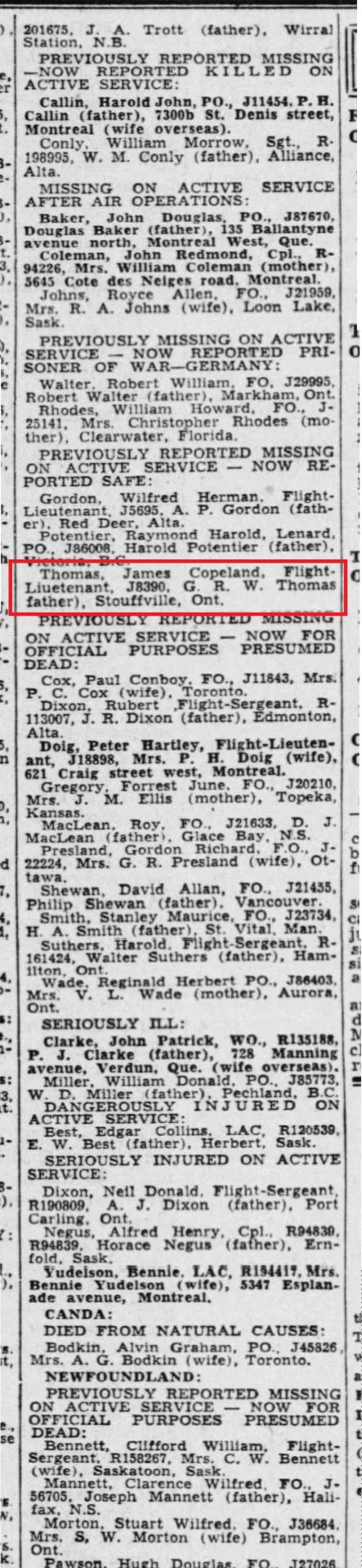
♦ Excerpt from the Quebec Gazette, dated October 21, 1944.
This newspaper article lists airmen reported missing on missions and specifies whether they are still missing, prisoners, or have escaped. It shows that James Copeland Thomas is declared safe. We learn that his father's name is G.R.W. Thomas, from Stouffville, Ontario. Note the misspelling of Thomas's rank: " Liuetenant " and not " Lieutenant. "
Ajouter un commentaire