6 July 1943
Vickers WELLINGTON Mk X (HF601 - code HD-?)
Porzliogan beach, Le Conquet (Finistère, Brittany)
(contributors : Daniel Dahiot, Philippe Dufrasne, Jean-Pierre Clochon, Thierry Grier)
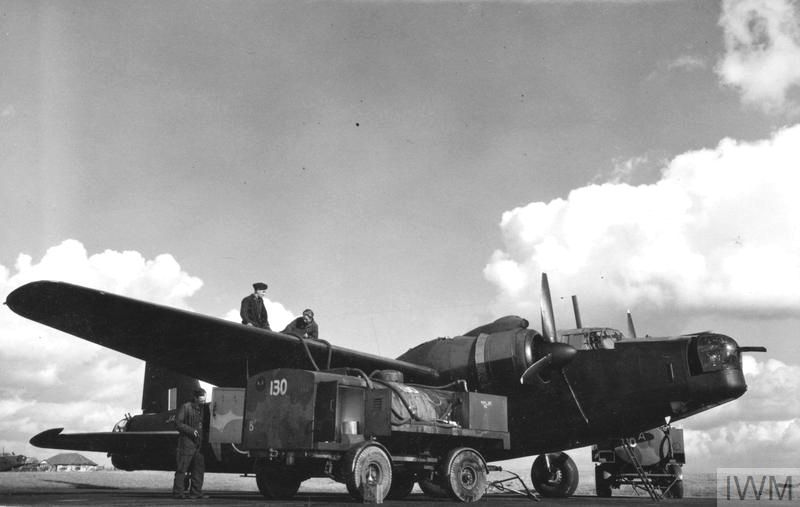
Vickers Wellington Mk X. © IWM (HU 93004)
Crew (No. 466 Squadron RAAF)
- Wing Commander (pilot) John Jervis OWEN, (No. 4 Group Uniy, service number 26062, Mentioned in Dispatches, RAF VR) 35 years old, killed.
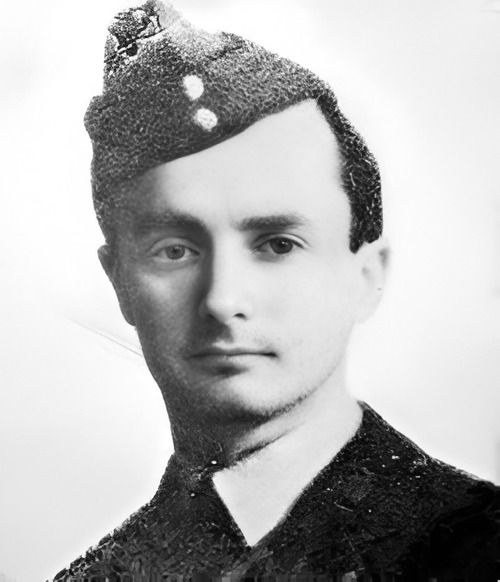
photo website World War Two Cemeteries - Thierry Grier
Son of John Alexander and Dora Sophia Owen (nee Jervis), husband of Rosemary Valerie Owen, from Feniton, Devon (England).
Municipal cemetery Le Conquet, grave 4
- Flying Officer (navigator) Hegbert Horace SWAIN (No. 196 Sqn, service number 119477, RAF VR), 32 years old, killed.
Son of Walter Egbert and Gladys Isabel Swain, Walthamstow, Essex (England)
Municipal cemetery Le Conquet, graves 1 to 3
- Flying Officer (bomb aimer) Frank DARBYSHIRE, (No. 196 Sqn, service number 126819, RAFVR), 21 years old, missing.
Son of George and Nora Darbyshire from Wath, Ripon, Yorkshire (England).
Runnymede Memorial, panel 124 (England)
- Pilot Officer (wireless operator, air gunner) Albert Morgan LONG, (No. 196 Sqn, service number J/17237, RCAF), 24 years old, killed.
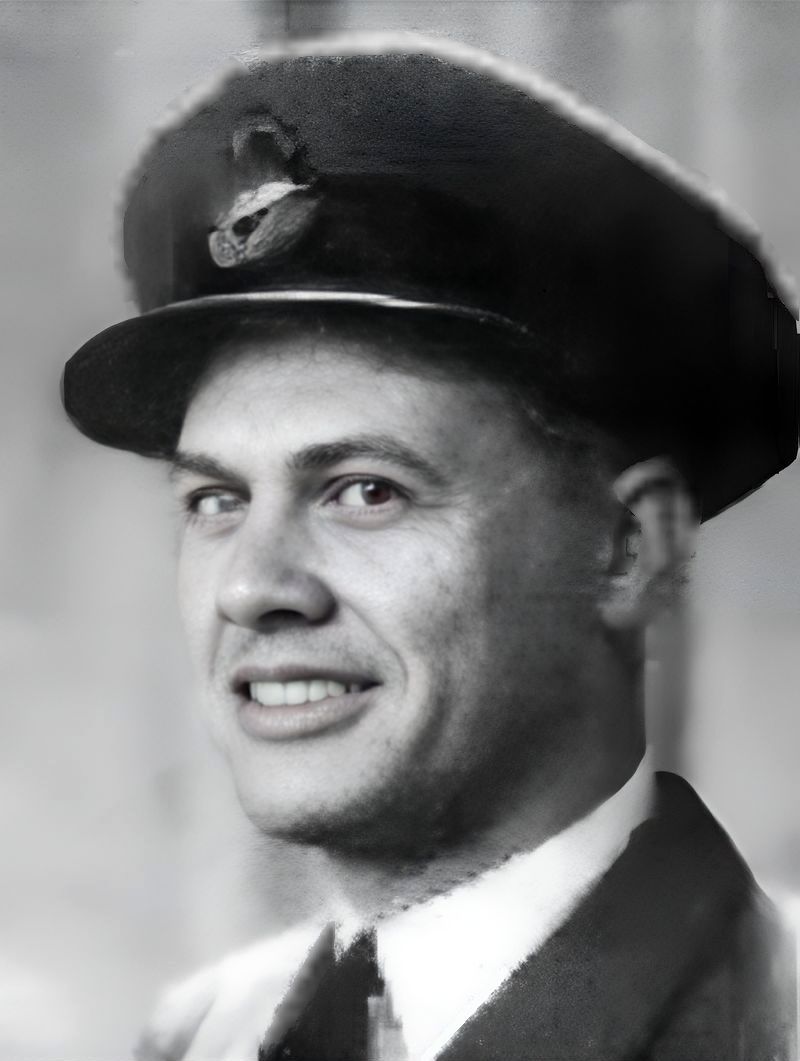
photo site Aircrew Remembered
Born on August 20, 1918 in Disley, Saskatchewan (Canada)
Son of Albert James and Miriam Long, from Prince Albert, Saskatchewan (Canada).
Municipal cemetery Le Conquet, graves 1 to 3
- Pilot Officer (air gunner) John Frederick " Johnny " RAY, (No. 196 Sqn, service number 145801, RAFVR), 22 years old, killed.
Son of Samuel and Daisy Florence Ray, from Brockley, London (England)
Municipal cemetery Le Conquet, graves 1 to 3
Acknowledgements : ABSA 39-45 warmly thanks Mr. Jean-Pierre Clochon, historian of Le Conquet, for allowing us to use information from his blog (link to the blog - in French only).
THE STORY
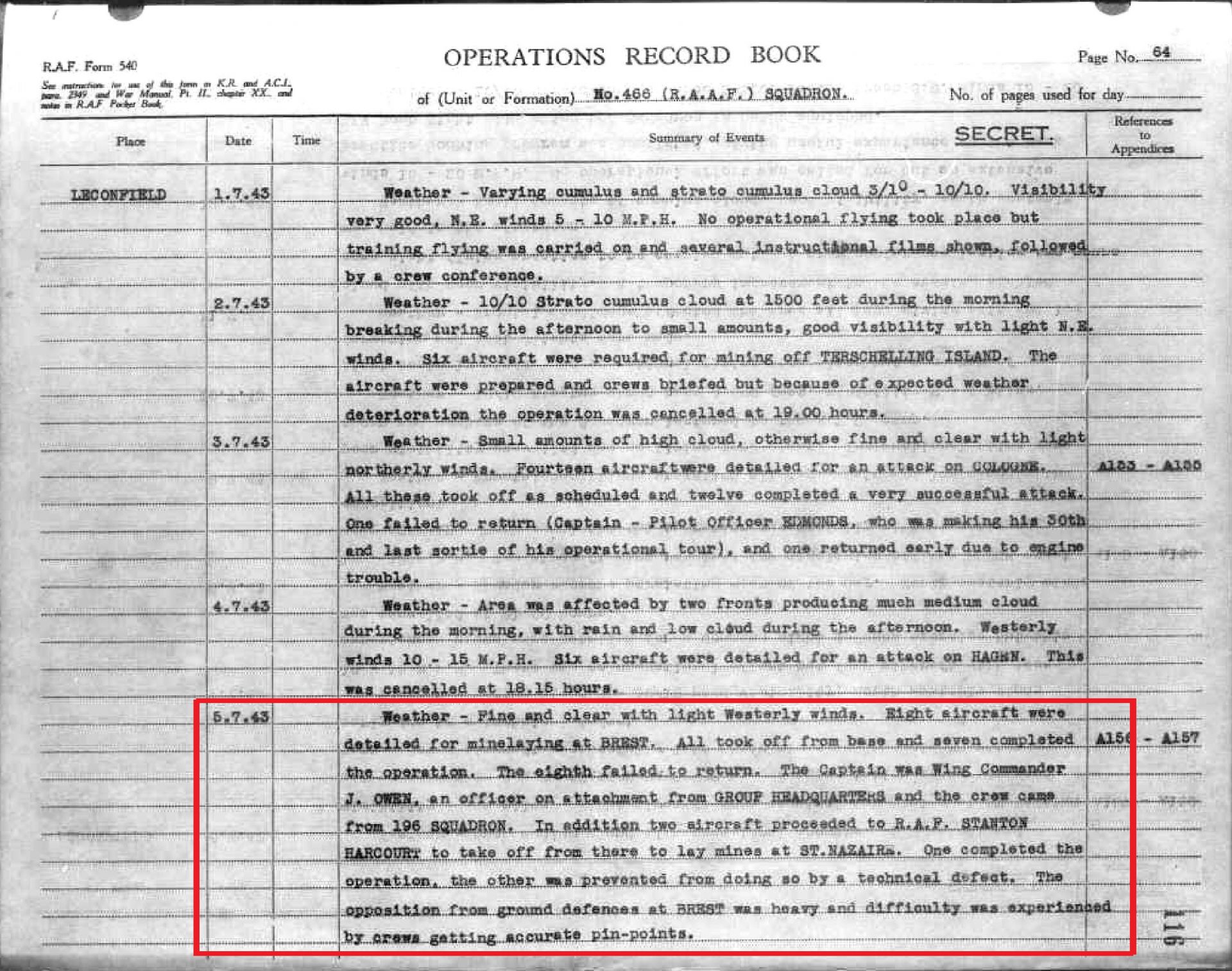
The operations log book of No. 466 Squadron RAF reports that on July 5, 1943, eight British Wellington Mk X bombers took off between 10:05 PM and 10:11 PM from RAF Leconfield (East Yorkshire) to lay mines off Pointe du Toulinguet (the tip of the Crozon peninsula, Finistère, Brittany). The Wellington Mk X was a standard bomber, equipped with two 1,675 hp Hercules engines, with a maximum speed of 483 km/h, a range of approximately 3,000 km, and a service ceiling of 6,710 meters. It could carry 2,250 kg of bombs, and its armament consisted of four machine guns.
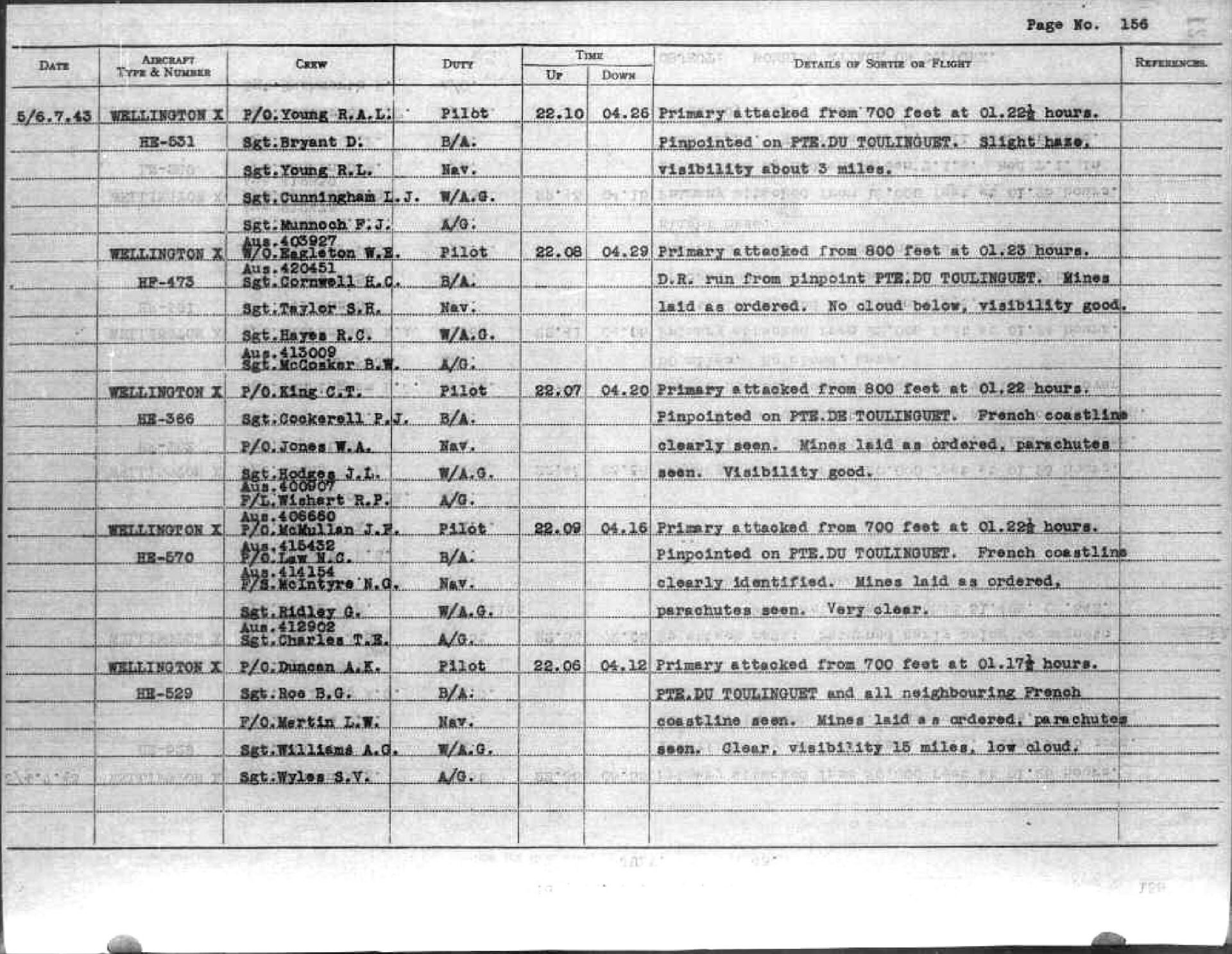
That night, visibility was good, around 25 km, the French coast was clearly identified, and the bomber group dropped its mines at the expected position between 1:17 and 1:27 AM, then turned back to return to England. Seven aircraft returned without incident to Leconfield (75 km east of Leeds), the eighth was reported missing.
Why did this aircraft, coming from Toulinguet or the surrounding area, end up in the water and sink at Porsliogan, after flying over Lochrist at very low altitude ? We have no answer to this question. Was the aircraft hit by anti-aircraft fire near Camaret, did it suffer engine damage, or did navigational errors lead it over anti-aircraft fire near Berheaume, then over Kéringar ?
TESTIMONIALS
(collected between 1990 and 1994)
A resident of Lochrist reported being awakened by anti-aircraft fire and the sound of aircraft engines flying very low, around 1:30 a.m., on July 6th. He got up, he said, and saw an aircraft caught in searchlight beams, hit directly by German fire, and crash into the sea.
Joseph Floc'h : " I heard an aircraft fly very low over my house in Lochrist, then nothing, the engine noise had stopped... The next day, I went to Porsliogan beach along the little Bilou path. In the cove north of Porsliogan, where the stream meets the river, there was an orange rubber dinghy with a yellow-orange liquid around it [a fluorescent liquid used to signal for help in case of shipwreck at sea]. I was told then, but I didn't see anything, that the only man wearing a flight suit had been killed falling from the cliff he was trying to climb. The others were in sweaters and underwear; they had been temporarily buried in the sand. A few days later, I saw the plane's landing gear displayed by the Germans at the entrance to the Dom Michel schoolyard. ".
Jean Le Bris, speaking of the three airmen in their underwear : " Hervé Cléach (a carpenter in Lochrist), who prepared their coffins, said they had been shot. The fourth, dressed as an airman, had been killed in a fall ; he had tried to climb the very steep right side of the ravine, while the left side was gently sloping. From Kérivin, we saw the aircraft flying in flames, then the engine noise stopped, but we didn't hear a crash... however, we could hear the German soldiers shouting. The next day, Jean Lucas towed the floating landing gear with his boat; he only had a 5/7 hp engine and couldn't reach the shore. He waited for the tide to turn, but with the incoming tide, he almost drifted off to the other side of Kermorvan. Fortunately, the winds came from the north, and he was able to return to port ».
RECONSTRUCTION OF THE EVENT
On July 6th, the Germans buried four bodies in the sand at the top of the beach. The end of the bomber's mission can apparently be reconstructed as follows :
Hit by anti-aircraft fire and/or suffering engine damage, it flew very low over Lochrist and continued to lose altitude while remaining perfectly level. The airmen knew that in a few minutes, the aircraft would land on the water and that the shore was close. They would have to get there : either with the rubber raft or by swimming. Three men were undressed and the fourth (perhaps he was the pilot still at the controls) remained in his flight suit ; the actions of the fifth are unknown. The plane touched down gently (some witnesses say there was no crash). In Porsliogan Bay, the wreck was sheltered from German long-range fire until the arrival of motorized units equipped with small arms. It was night. The four or five men launched the raft and paddled toward the beach with the energy of despair. Before reaching the shore, those who were naked jumped into the water and swam to shore just as the Germans arrived from the top of the beach. They made perfect targets and were shot down as soon as they set foot on the sand. In their haste, the Germans didn't see the fourth man who had landed with the raft in the cove to the north. He was probably killed falling from the cliff he was trying to climb. The body of the fifth man was never recovered, but perhaps he was already dead (or wounded) in the plane, hit by anti-aircraft fire ?
(Some witnesses now claim that the bodies bore no bullet wounds, which would contradict the scenario described above. But then how can we explain the bodies being found together ? If the airmen had drowned while leaving the aircraft, their bodies, carried away by the currents, would not have been found the same day, and certainly not in Porsliogan).
On July 6, 1943, the Germans buried the bodies in the sand and prohibited the public from accessing the beach ; they were undoubtedly still searching for possible survivors. The aircraft's landing gear, lifted by its large tires, broke away from the fuselage and resurfaced later that day. It was towed to Le Conquet, as mentioned earlier, and displayed to the public in the schoolyard.
One question remains, however : if the Germans shot at the airmen, one can ask " why ? " because at that time, it was not their custom to eliminate unarmed enemies, especially before questioning them.
THE BURIAL OF THE AIRMEN
The mayor at the time, Louis Simon, requested permission from the Germans to bury the bodies of the Allied airmen in the municipal cemetery. Since they had abandoned their investigations, they granted the requested permission on the morning of July 8th. The mayor assembled a team to carry out the operation.
A document from the town hall (expense report) specifies : " Work carried out on July 8, 1943. Coffins and placing bodies in coffins at Porsliogan : Hervé Cléach. Transport from Porsliogan to Lochrist : Hervé Lannuzel. Digging of the grave : Laurent Ropars ". (Some witnesses claim that the bodies were transported from Porsliogan to Lochrist by Mrs Magueur's truck).
The airmen were buried on July 8, 1943, at 2 p.m., in the presence of Mayor Simon, the constable Pierre Paugam, and a crowd of residents who gathered in remembrance. Miss Paule Jestin recounts : “ I was at the cemetery with many other residents of Le Conquet. The burial ceremony had begun when a group of armed Germans arrived. We were very frightened ; we thought they were going to shoot us. In fact, they had come to pay military honors to the airmen ”.
IDENTIFICATION OF THE BODIES
A document from Le Conquet town hall states :
Four bodies were buried in Lochrist in four different graves in 1943 : two are identified, J.J. Owens, service number 26062, and Swain, service number 119477 ; the other two are listed as " unknown ". The Lochrist cemetery still contains the white tombstones of the four airmen, bearing the names Owen, Swain, Long, and Ray. The bodies were likely exhumed after the war to facilitate identification and confirm that the missing man's body was that of Lieutenant Darbyshire.
The name of Flying Officer Frank Darbyshire appears on the Runnymede Memorial (Egham, Surrey, England) followed by the mention " assumed lost at sea, 6 July 1943 ".
IN MEMORIAM
♦ Stele erected in 1993 in memory of the crew of the Wellington Mk X HF601
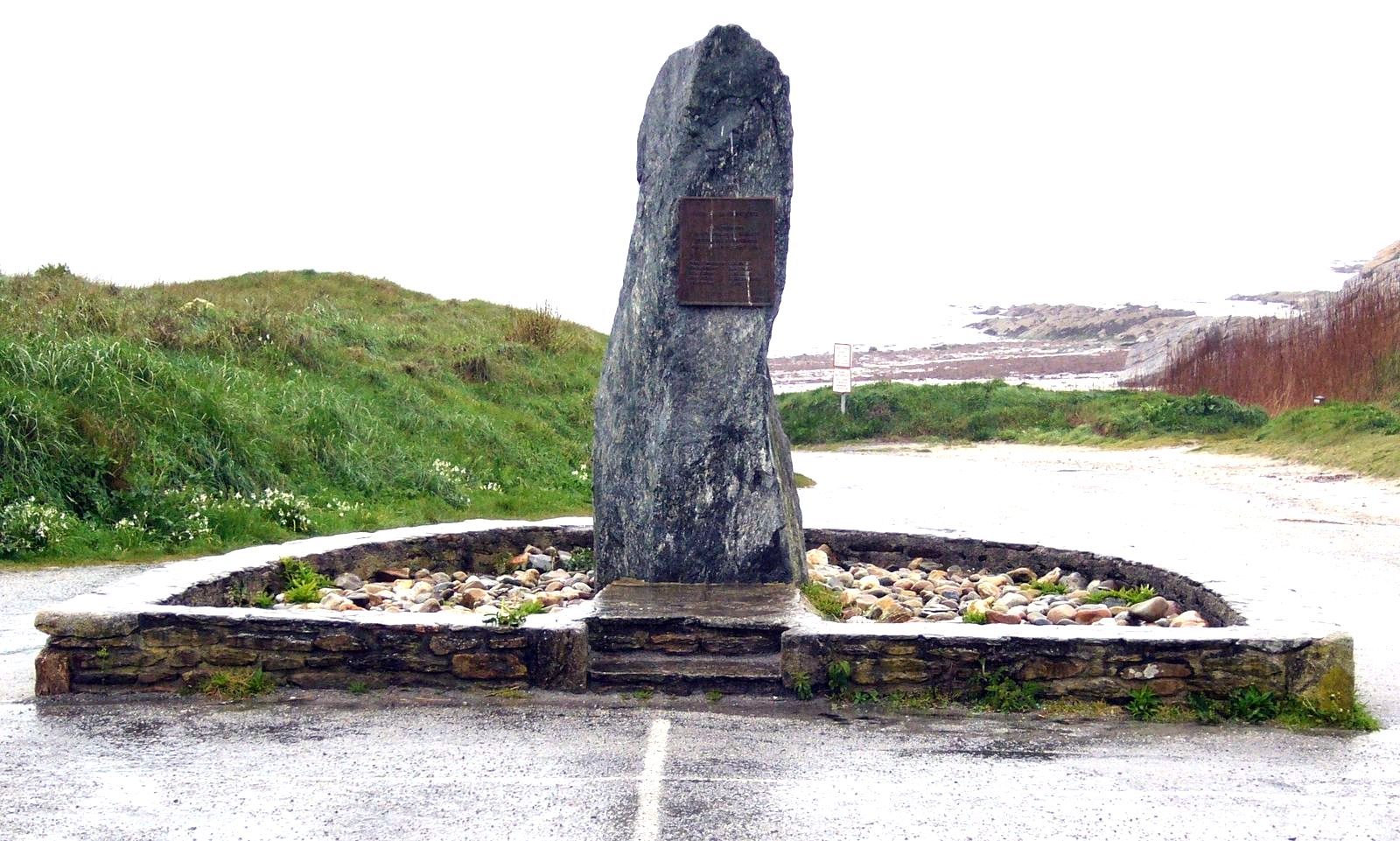
Photo collection Jean-Pierre Clochon
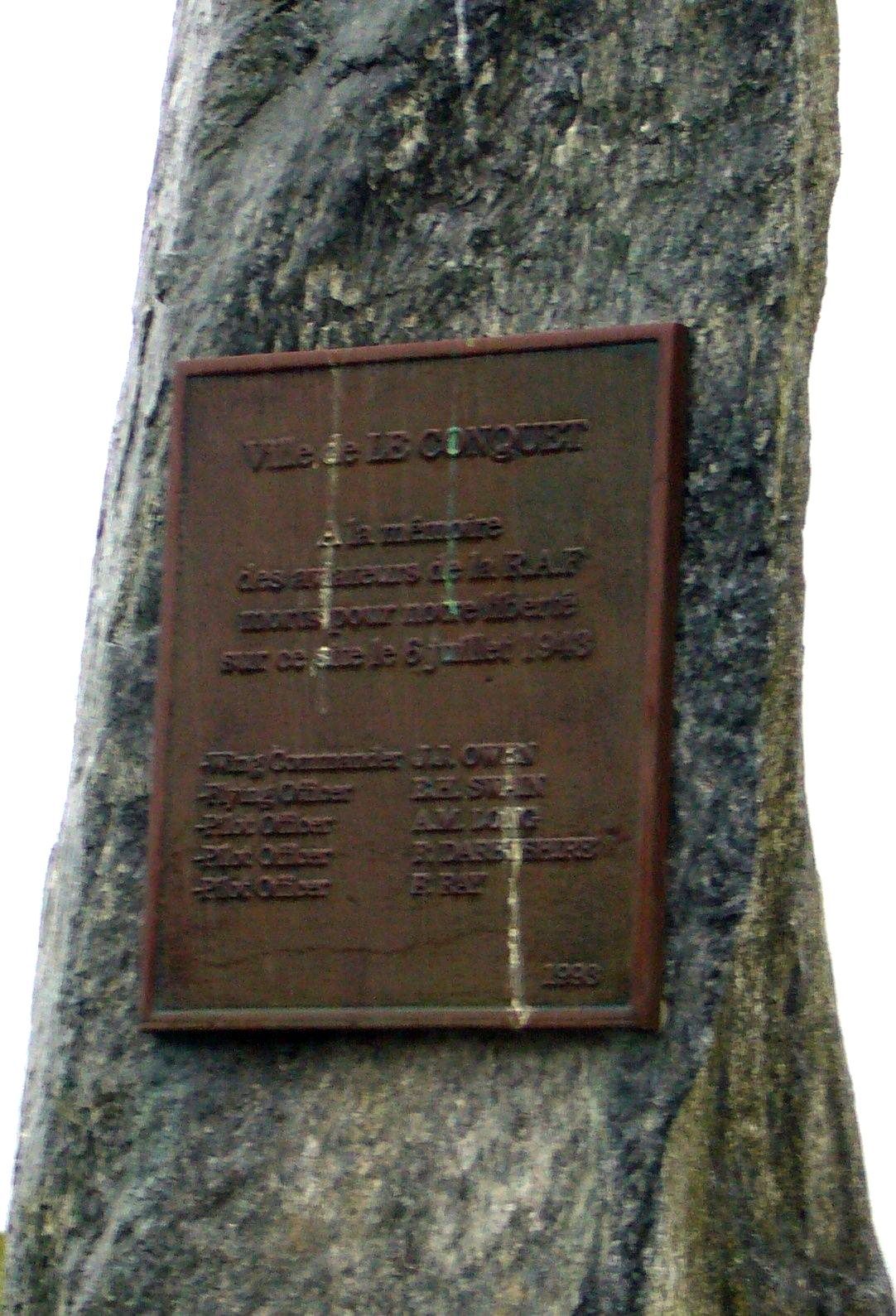
Photo collection Jean-Pierre Clochon
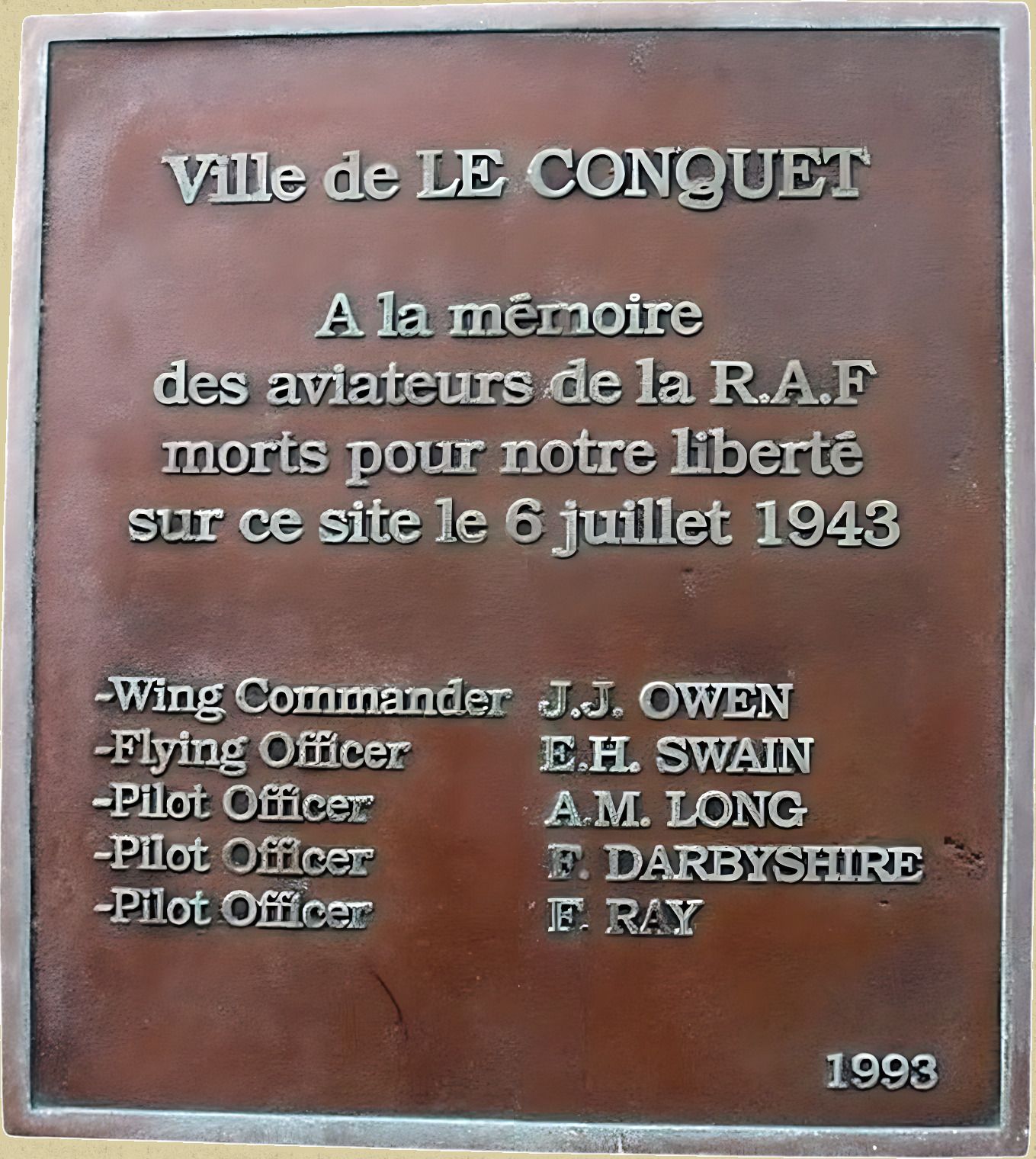
Photo collection ABSA 39-45
♦ Memorial plaque in tribute to Albert Morgan Long, in Long Bay at Wildnest Lake, Saskatchewan (Canada)
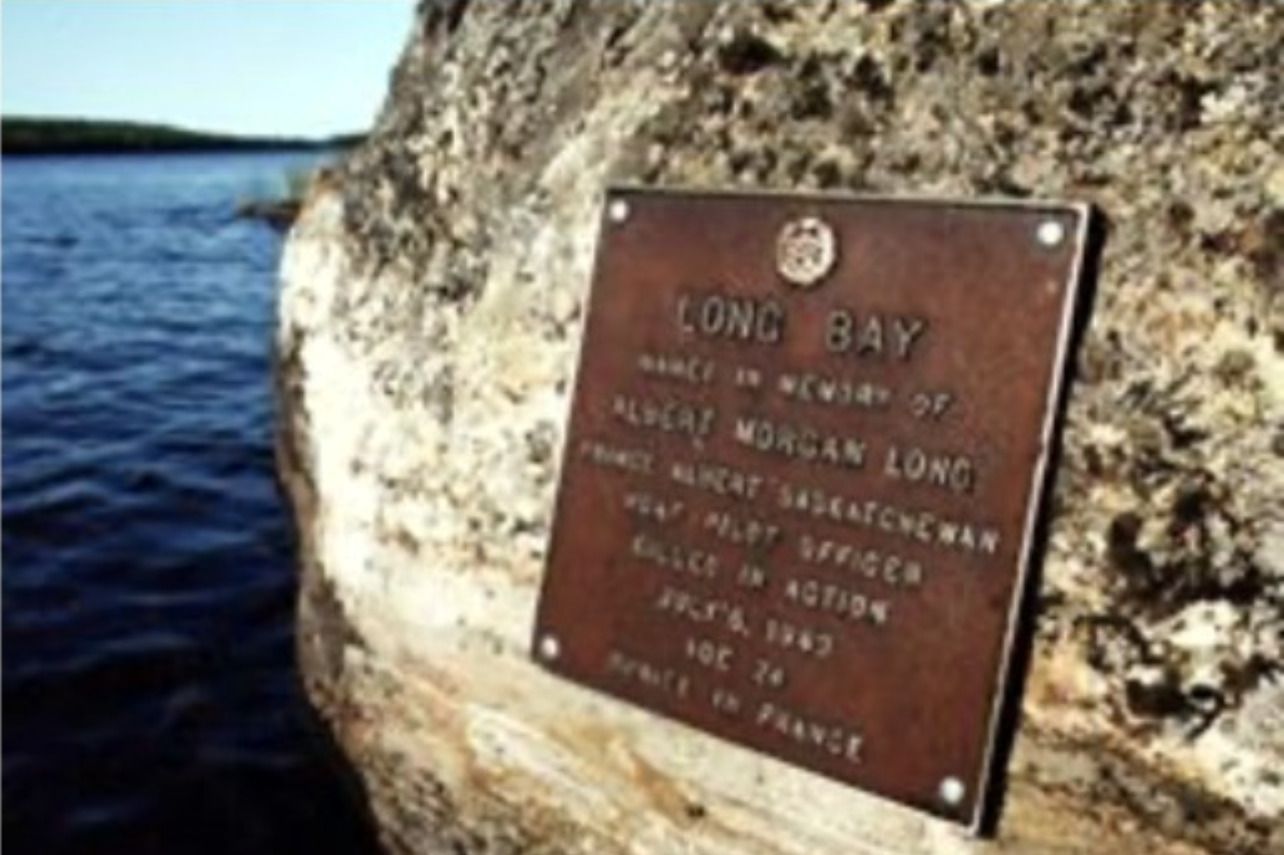
photo site Aircrew Remembered with courtesy of Tedd Smith
♦ Graves of 4 of the 5 crew members in the municipal cemetery of Le Conquet (Finistère, Brittany).
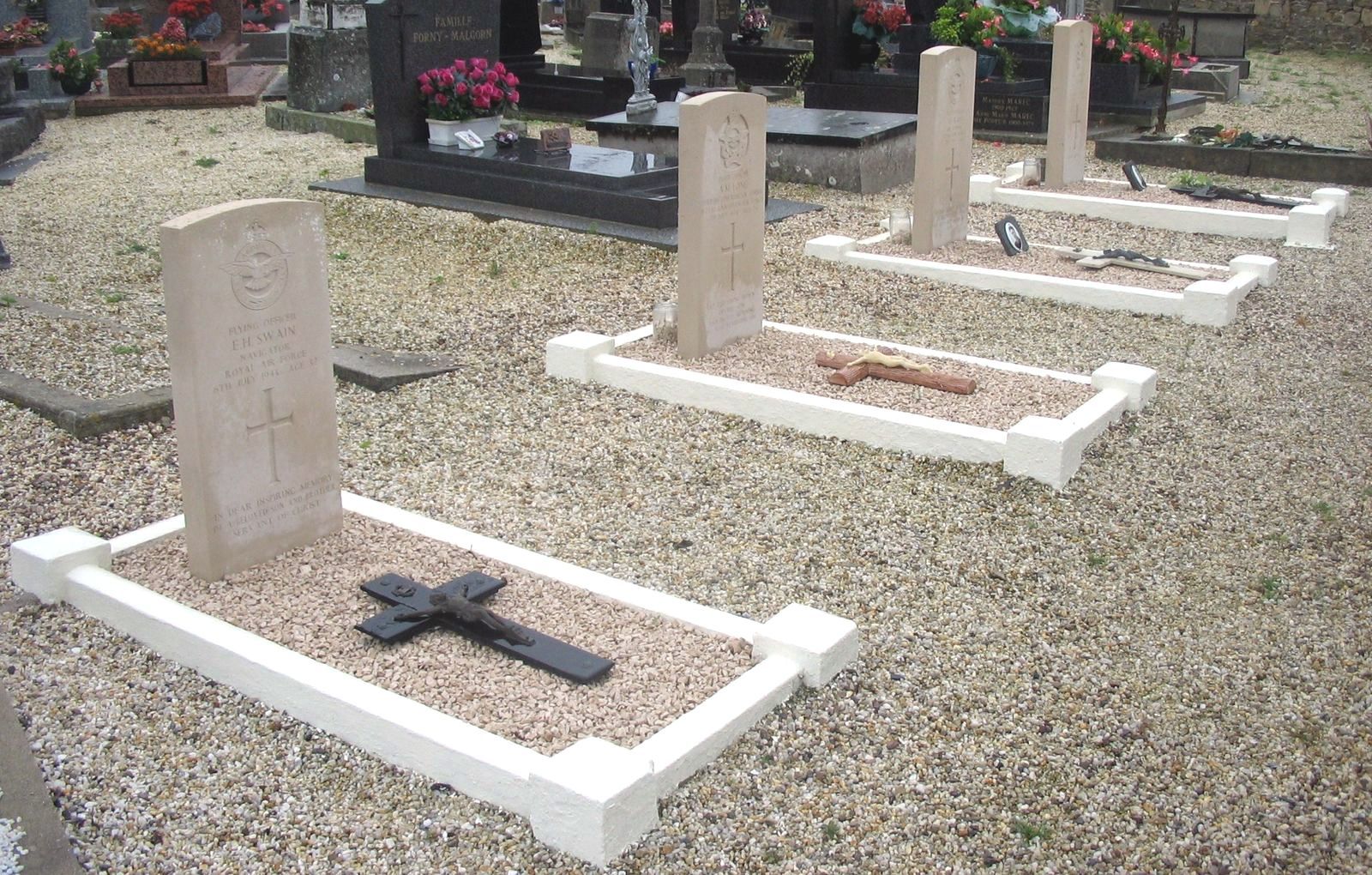
The graves of airmen SWAIN, LONG, RAY and OWEN
Photo collection Jean-Pierre Clochon
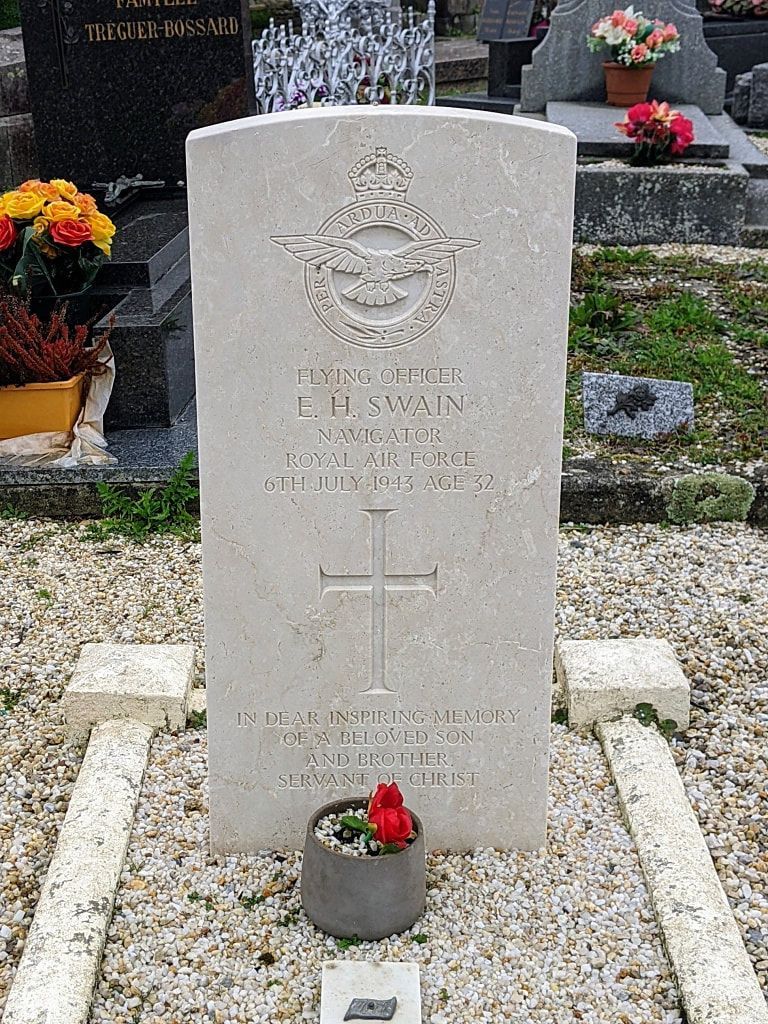
Grave of Egbert Horace SWAIN
photo website World War Two Cemeteries - Thierry Grier
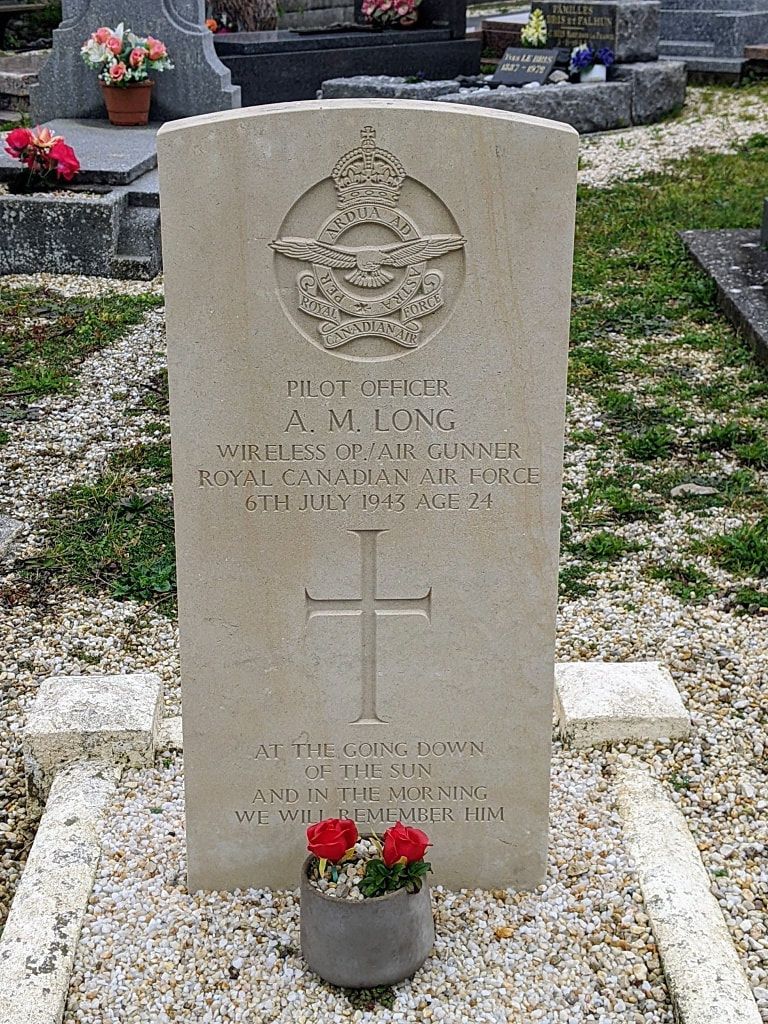
Grave of Albert Morgan LONG
photo website World War Two Cemeteries - Thierry Grier
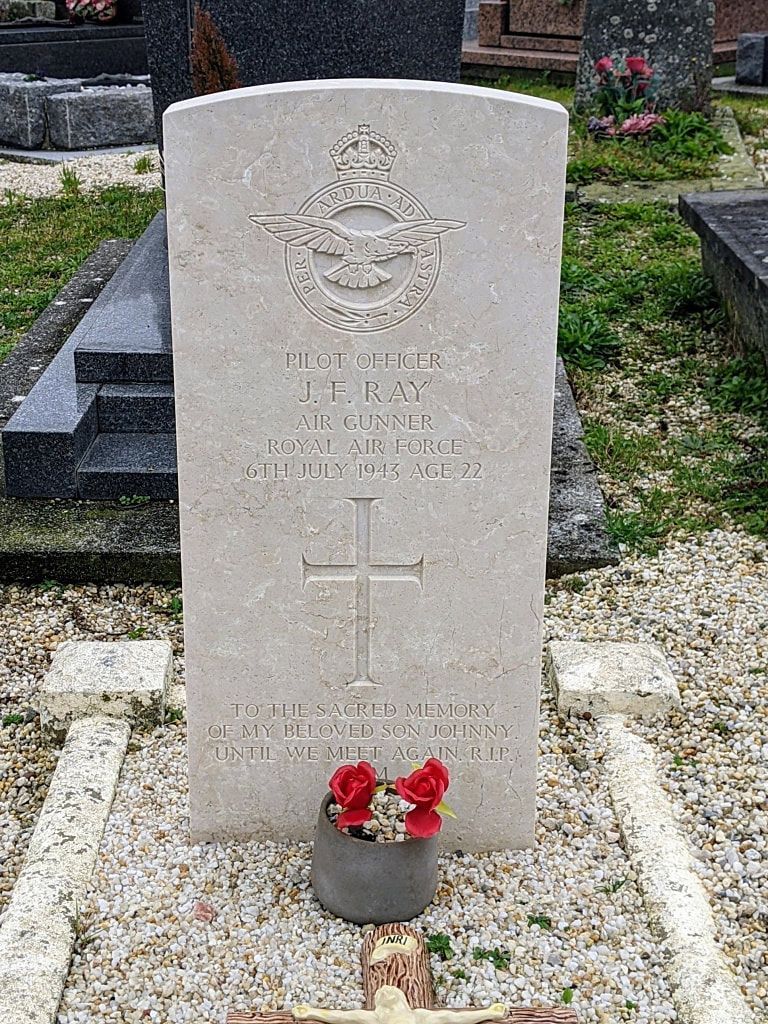
Grave of John Frederick RAY
photo website World War Two Cemeteries - Thierry Grier
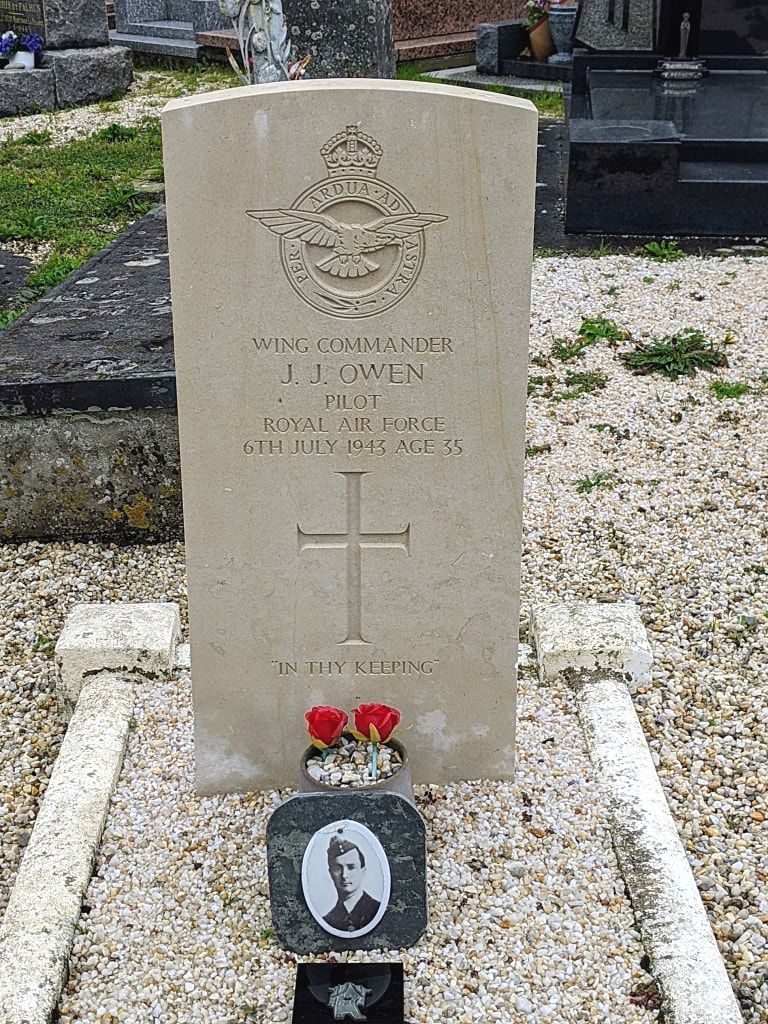
Grave of John Jervis OWEN
photo website World War Two Cemeteries - Thierry Grier
♦ Name of the only missing airman, Frank DARBYSHIRE, at the Runnymede Memorial in England.
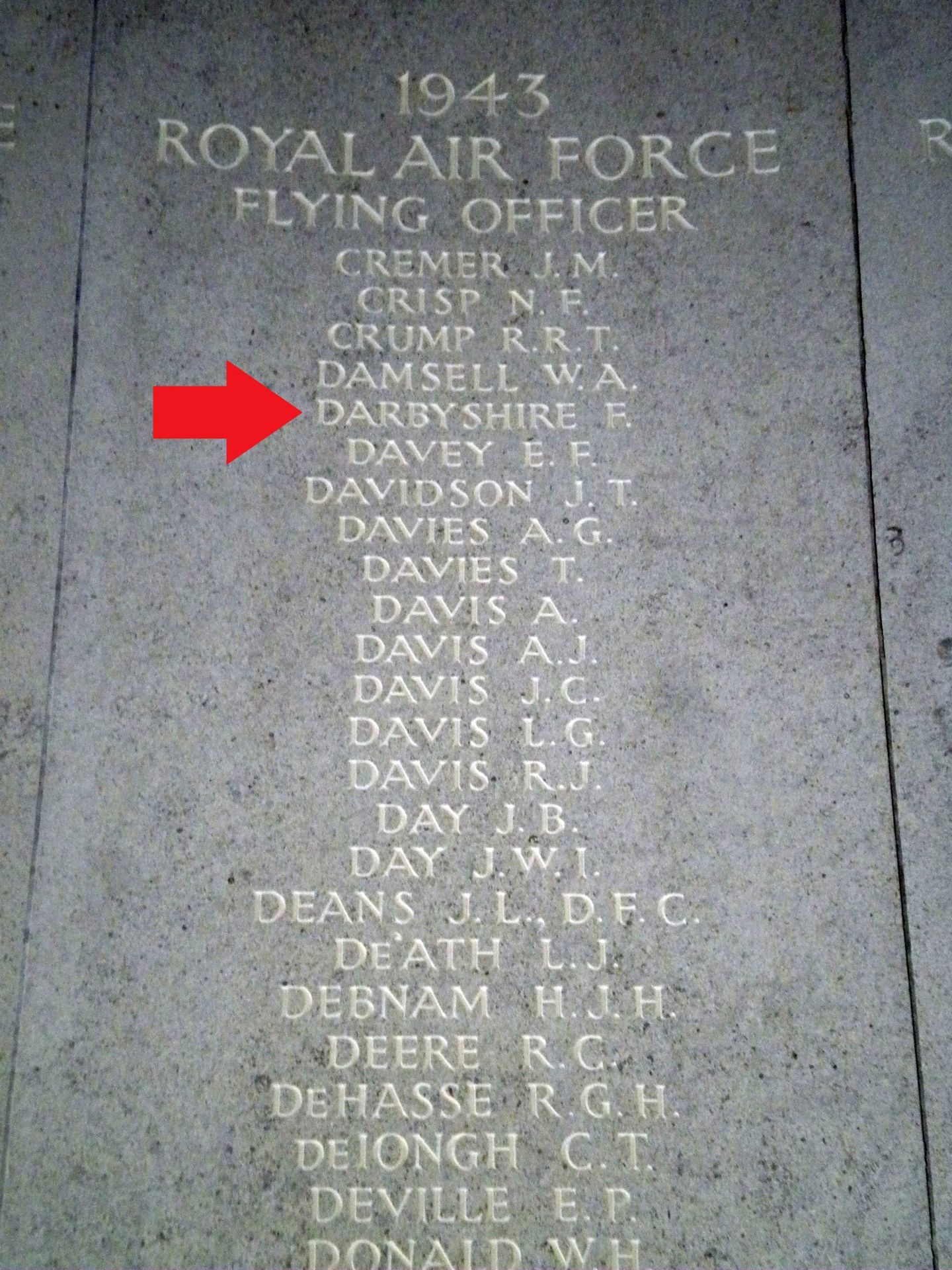
Photo collection Jean-Pierre Clochon
♦ Bomber Command Memorial Wall, Nanton, Alberta (Canada)
On this wall is the name of Albert Morgan Long, who belonged to the RCAF
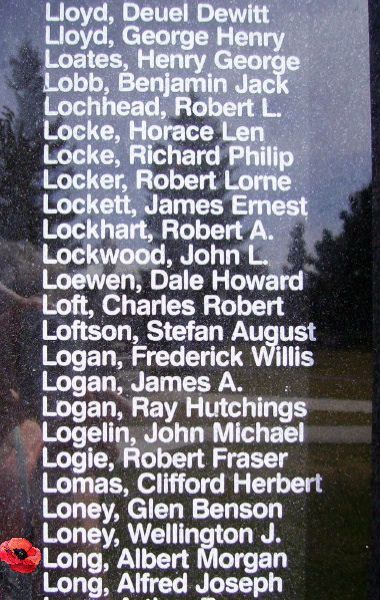
photo Veterans Affairs Canada with coiurtesy of Marg Liessens
PILOT OFFICER ALBERT MORGAN LONG (RCAF) (information source Veterans Affairs Canada)
The " Veterans Affairs Canada " website contains various documents relating to Pilot Officer Albert Morgan Long, which provide some information about the life of the unfortunate aviator. These documents are presented in chronological order.
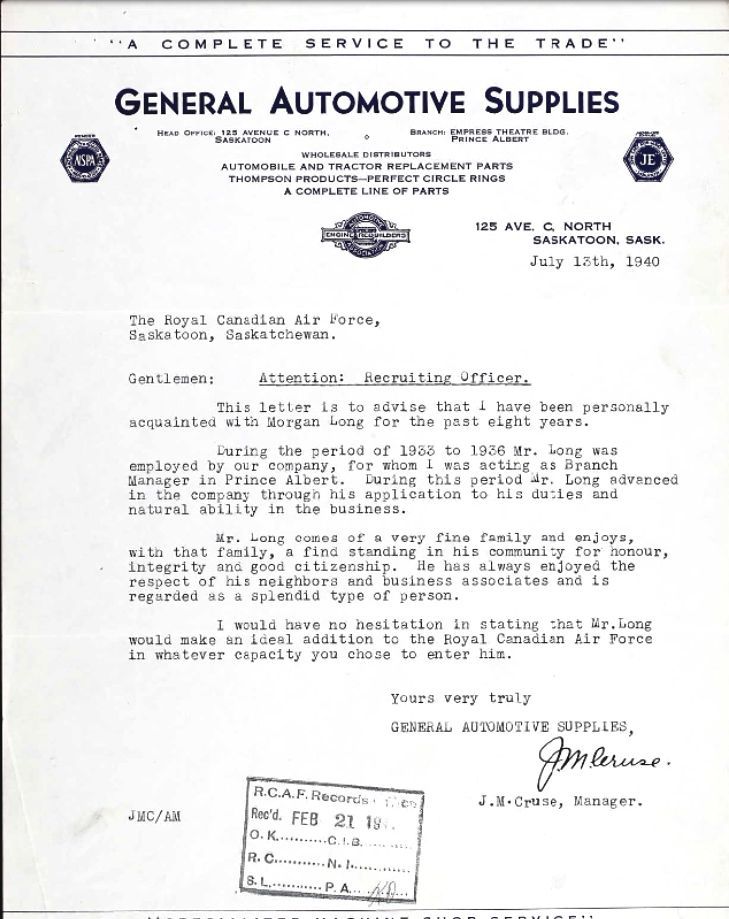
♦ Letter of recommendation from Albert M. Long's employer (General Automotive Supplies) to RCAF recruiters
In this document, Long's manager praises his qualities of honor, citizenship, integrity, and respect.
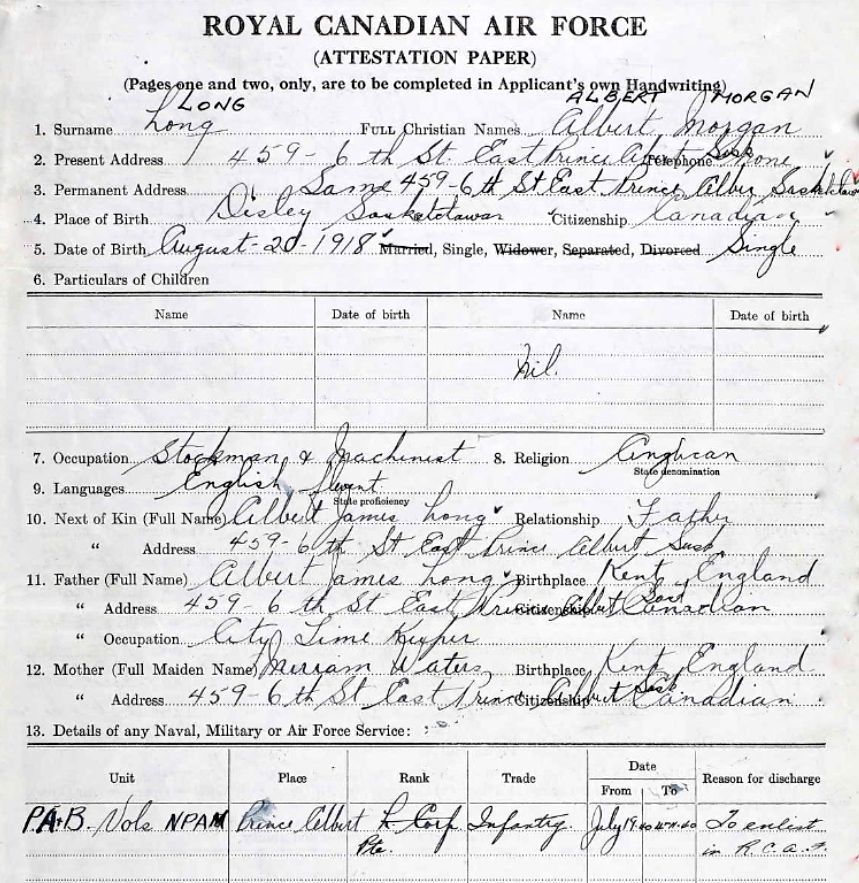
♦ Attestation of RCAF
This document tells us that Albert M. Long's parents were born in Kent, England, that Long was Anglican, and that he was first in the infantry before joining the RCAF (it seems he was in the infantry from July 19, 1940 to November 4, 1940).
document Veterans Affairs Canada
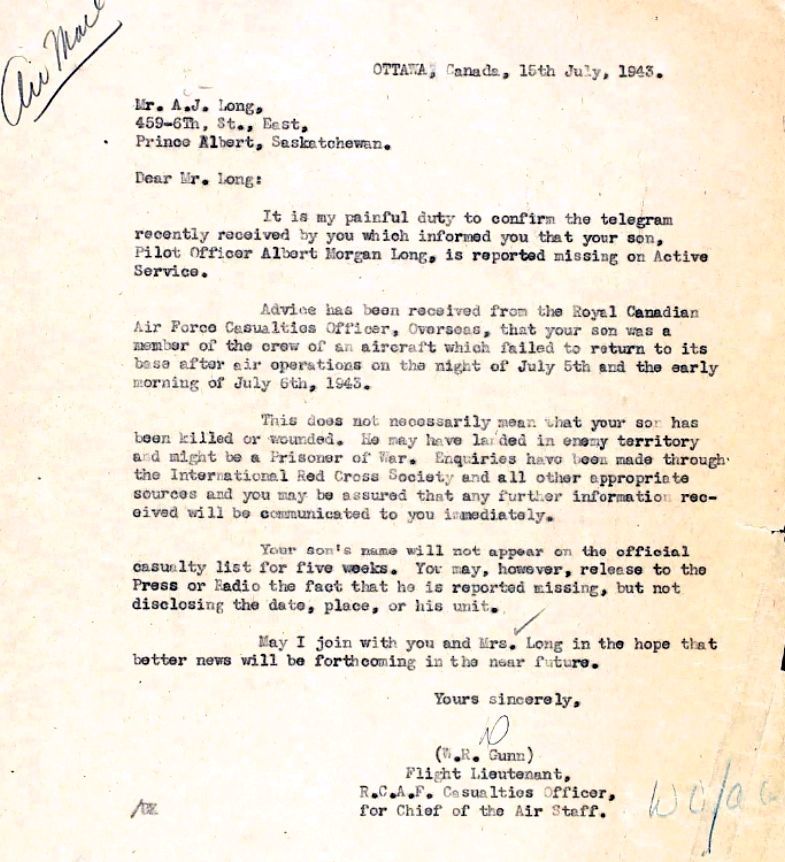
♦ Letter informing P/O. Long's parents of his disappearance, dated July 18, 1943.
In this letter, F/L. Gunn explains that missing does not mean killed or wounded. He asks A.M. Long's parents not to disclose to the press the date and location of the crash or their son's unit
document Veterans Affairs Canada
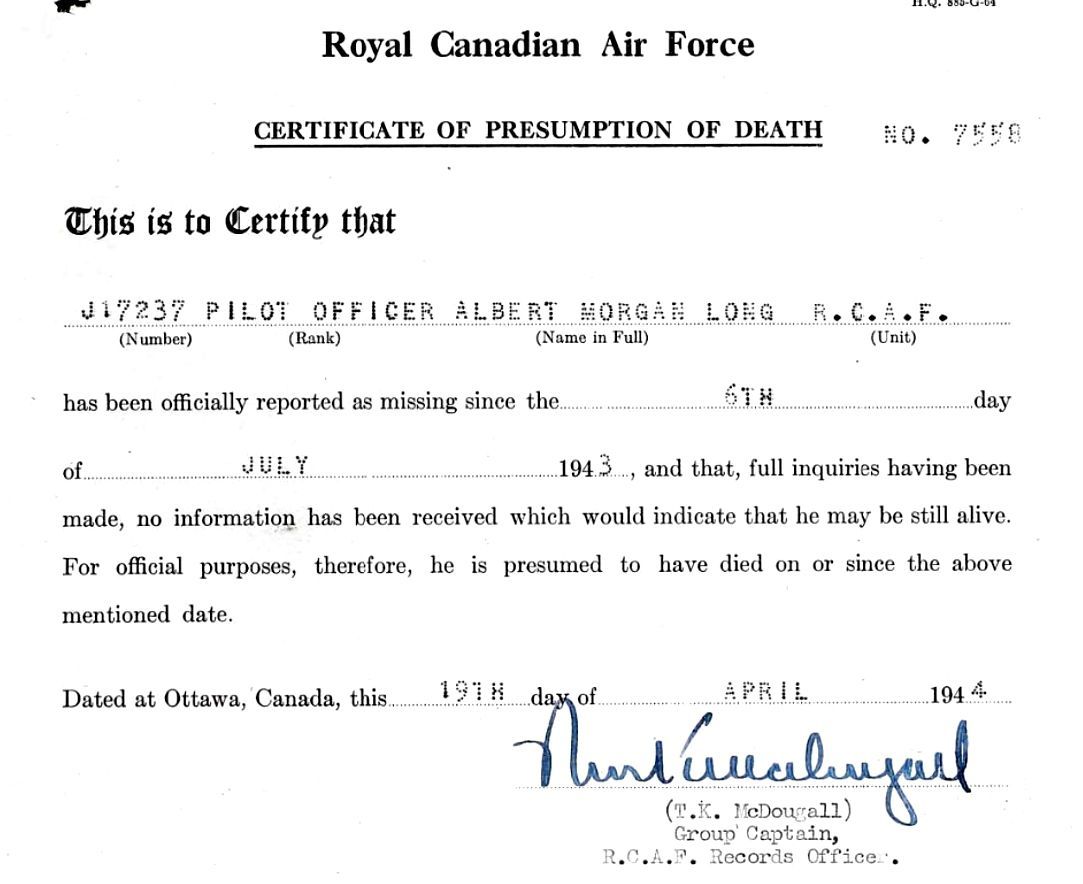
♦ Certificate of presumption of death for Albert Morgan Long, dated April 19, 1944.
document Veterans Affairs Canada
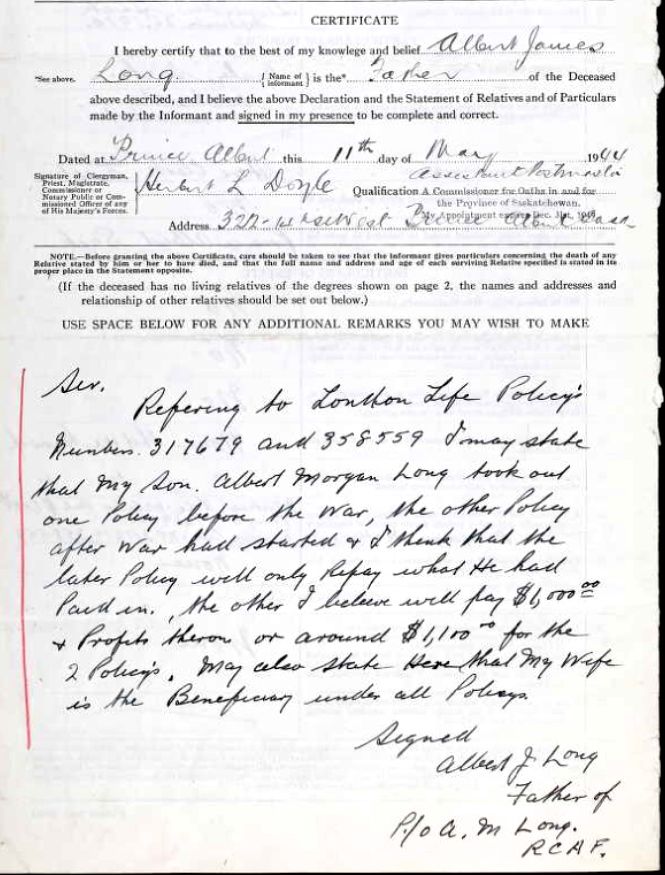
♦ Letter from Albert James Long, father of Albert Morgan Long, dated May 11, 1944.
We learn that Albert Morgan had taken out insurance policies for which his parents were the beneficiaries (value approximately $1 000).
document Veterans Affairs Canada
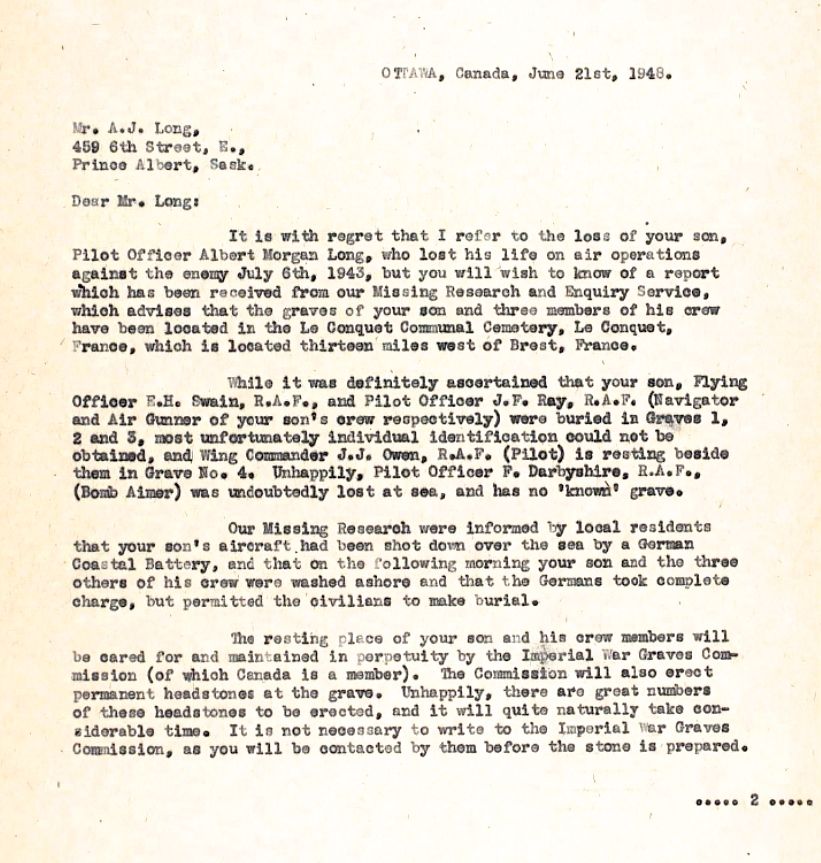
♦ Letter to the parents of Albert Morgan Long, dated June 21, 1948.
This letter confirms Long's death. It informs the parents of the circumstances surrounding the disappearance of the airman and his comrades, as well as his burial place in Le Conquet. We learn that Long is buried with Flying Officer Swain and Pilot Officer Ray in graves 1 - 3, while Wing Commander Owen is in grave 4.
APPENDICES
♦ Extract of document AIR-27-1925-15 (Operational Record Book no 466 Squadron RAF) for the date of July 6, 1943
♦ Extract of document AIR-27-1925-16 (Operational Record Book no 466 Squadron RAF) for the date of July 6, 1943
This document lists the eight aircraft and their crews. It shows that all eight aircraft took off between 10:05 PM and 10:11 PM. HF601 was the last to take off. The seven aircraft that returned from their missions arrived between 4:12 AM and 4:32 AM on July 6th. It also reveals that the crew of HF601 was from No. 196 Squadron RAF and that the Wing Commander was from No. 4 Group Unit.
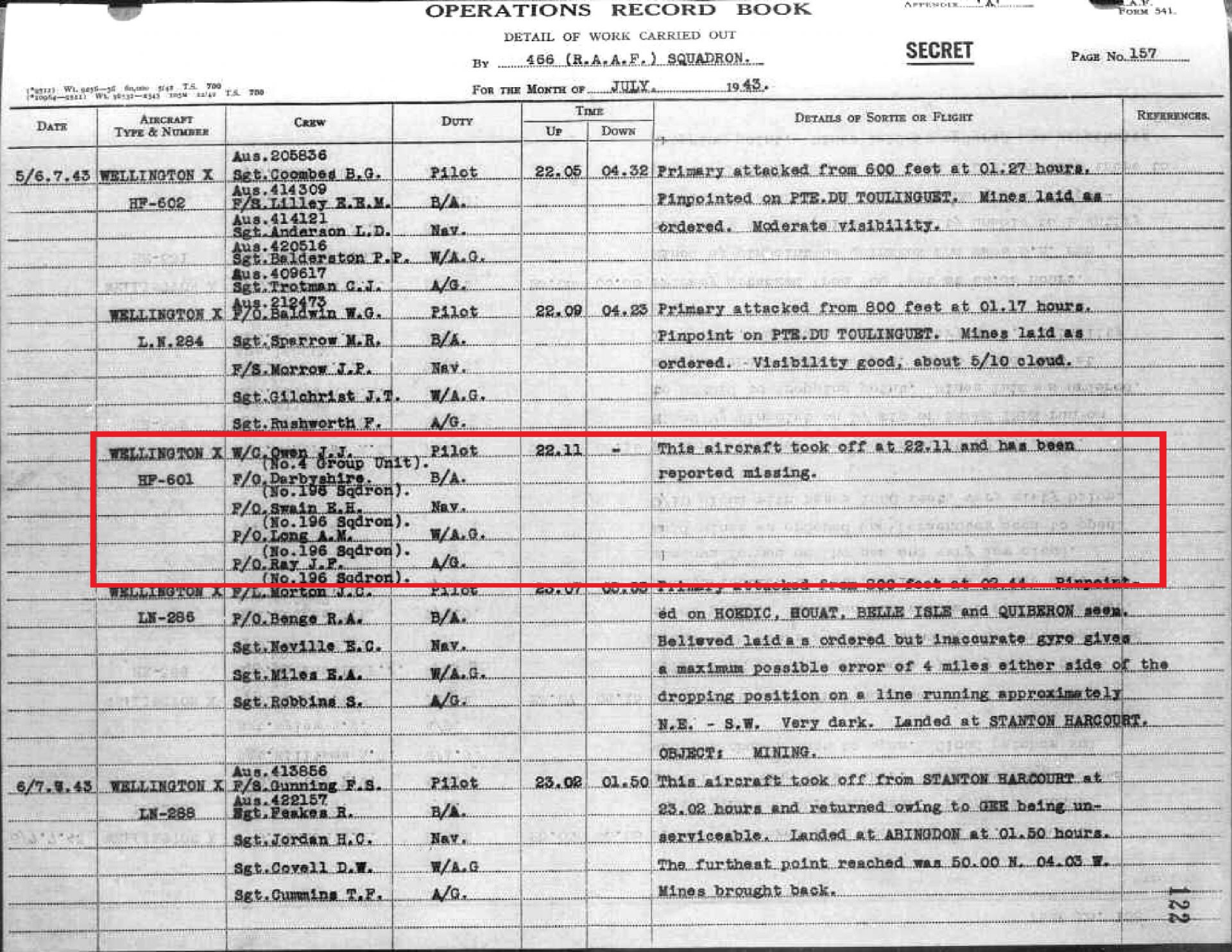
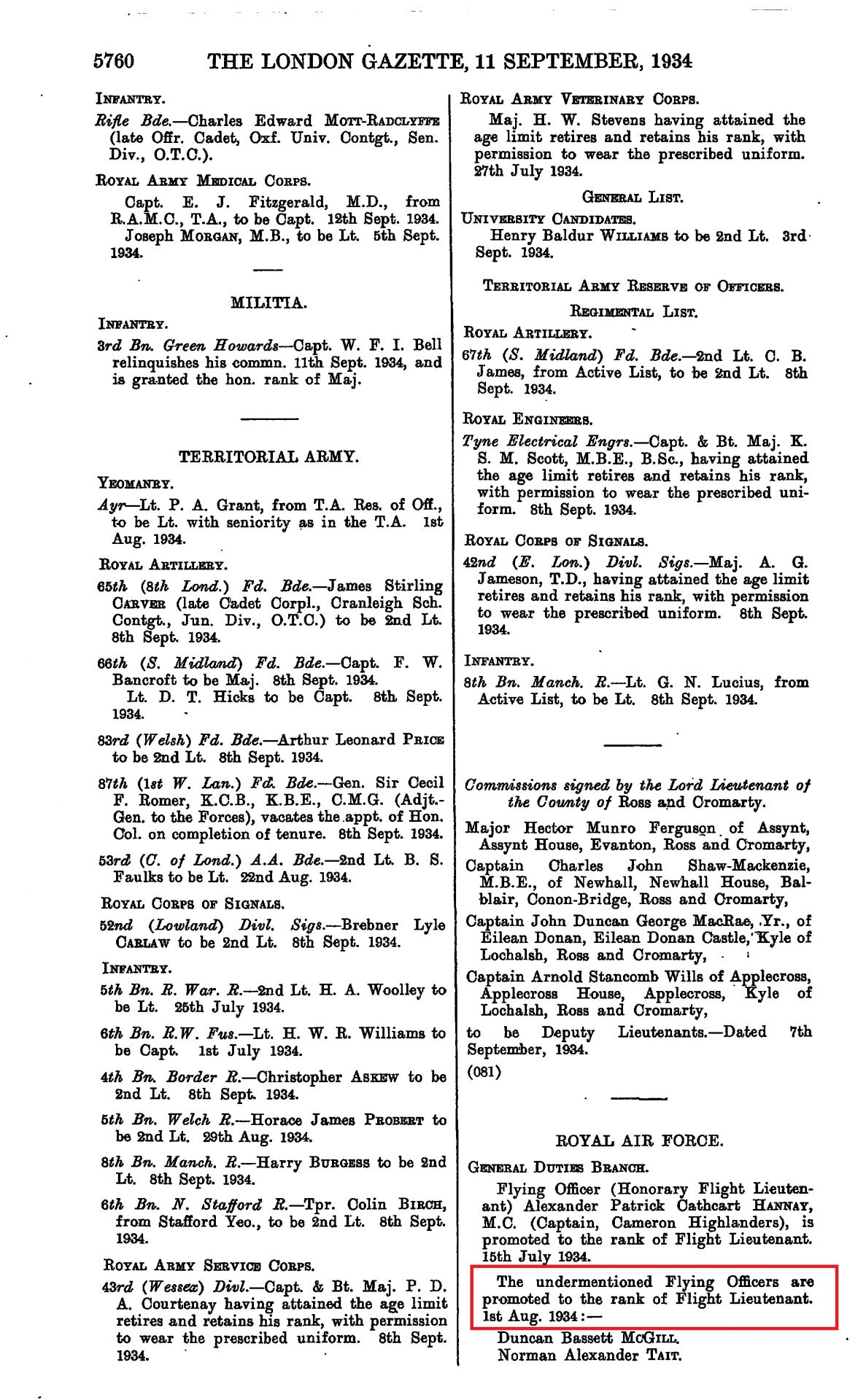
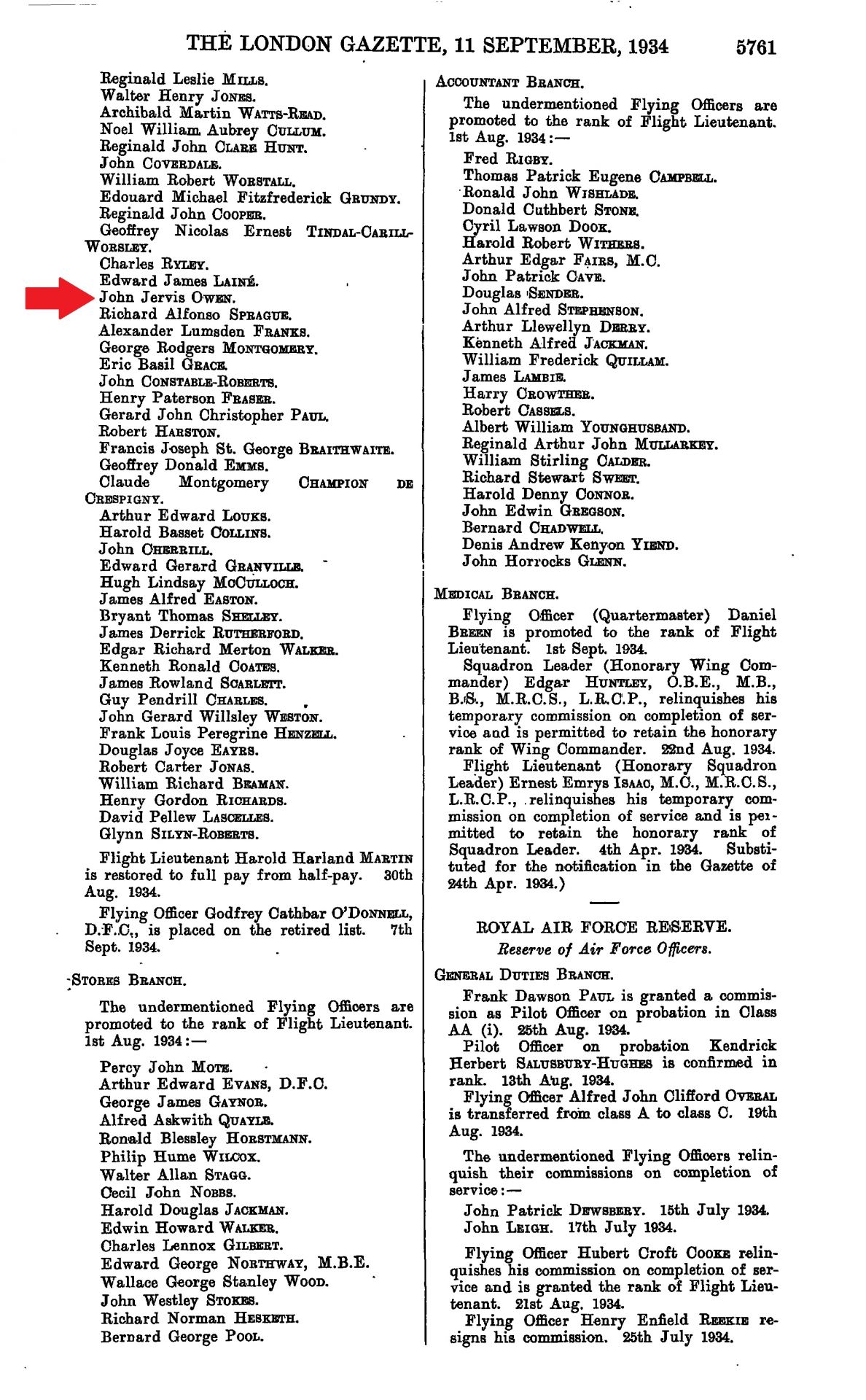
♦ " The London Gazette ", 11 September 1934 : publication of John Jervis Owen's promotion from Flying Officer to Flight Lieutenant on August 1, 1934.
(source " The Gazette ")
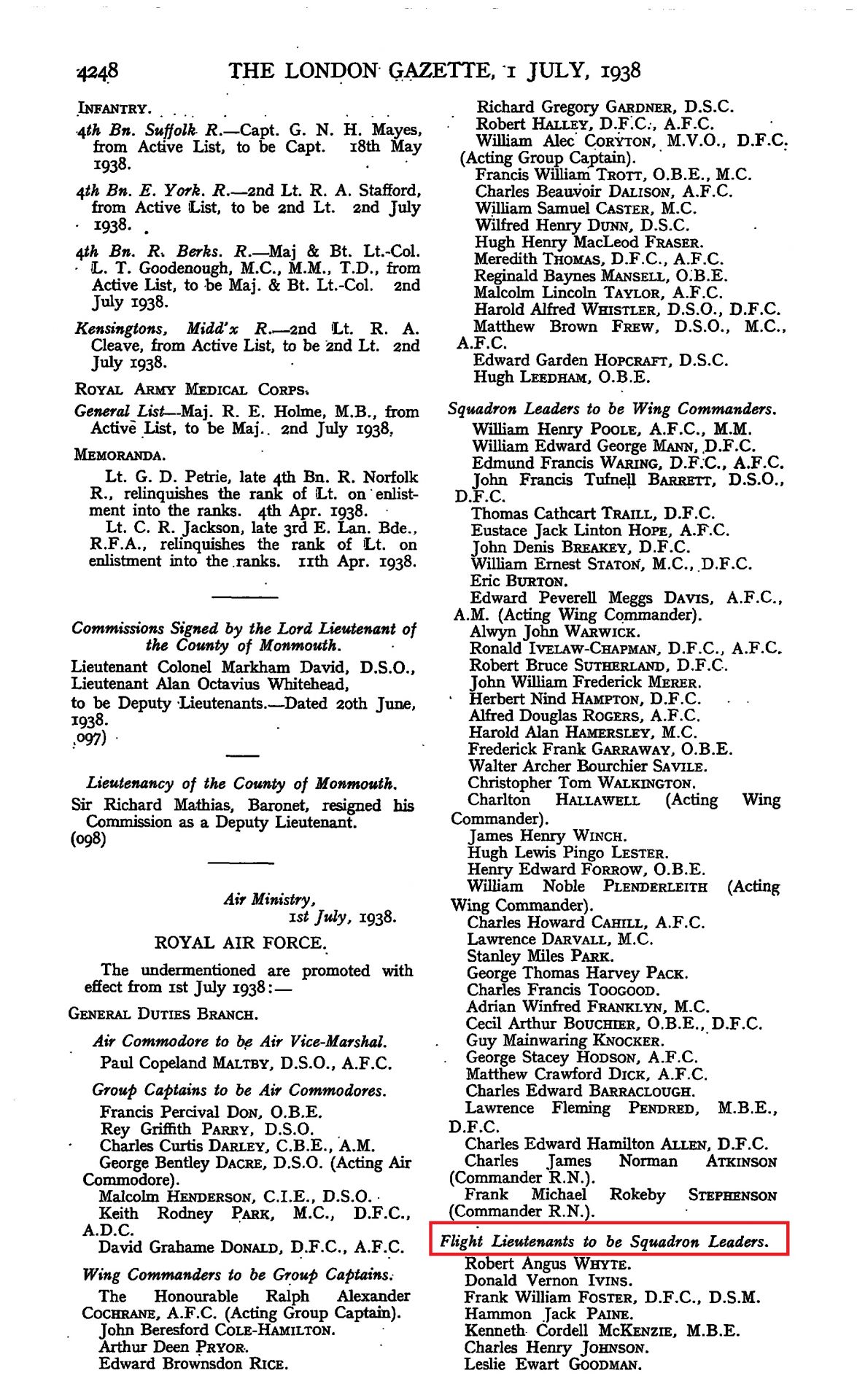
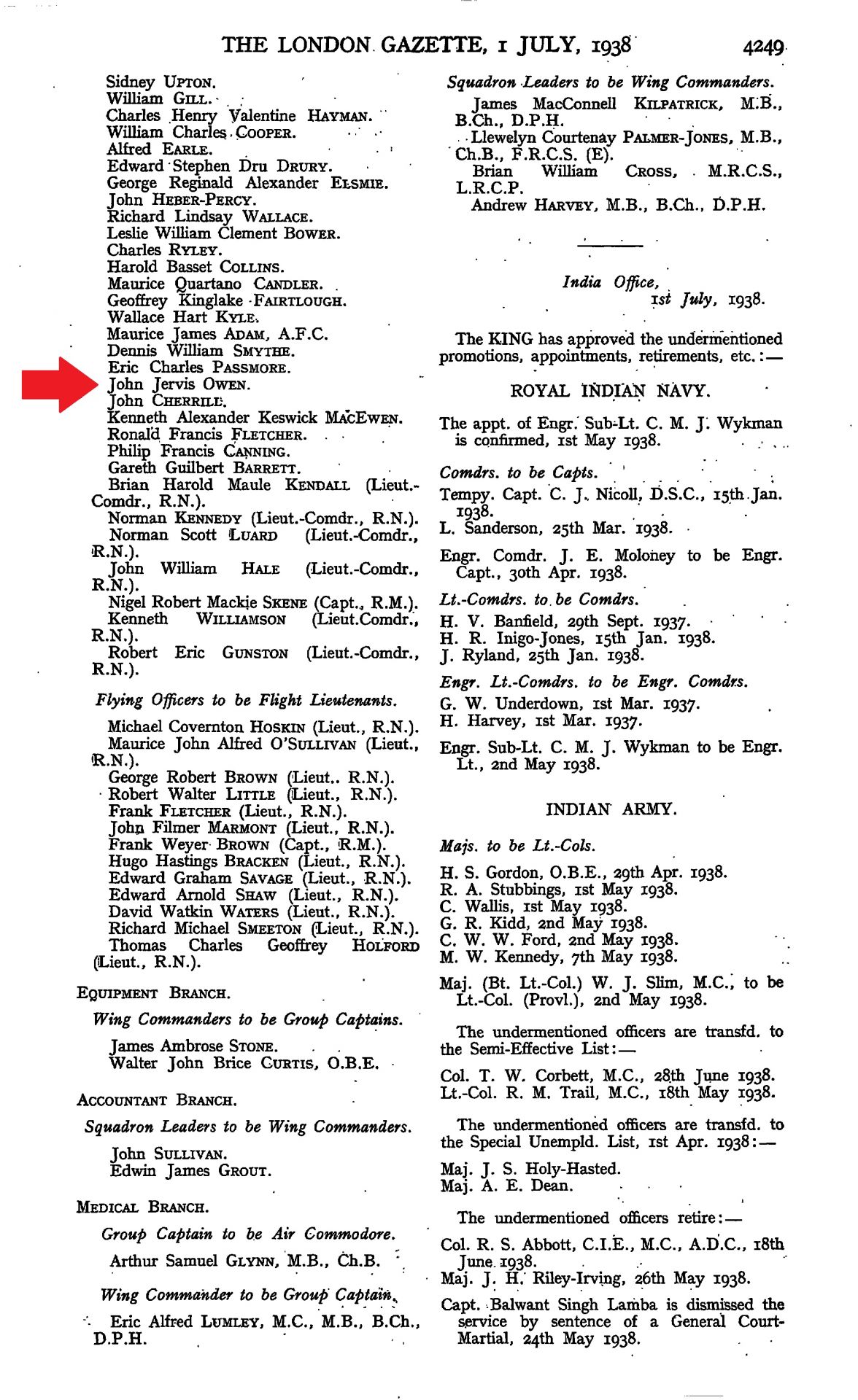
♦ " The London Gazette ", 1 July 1938 : publication of John Jervis Owen's promotion from Flight Lieutenant to Squadron Leader on July 1st, 1938.
(source " The Gazette ")
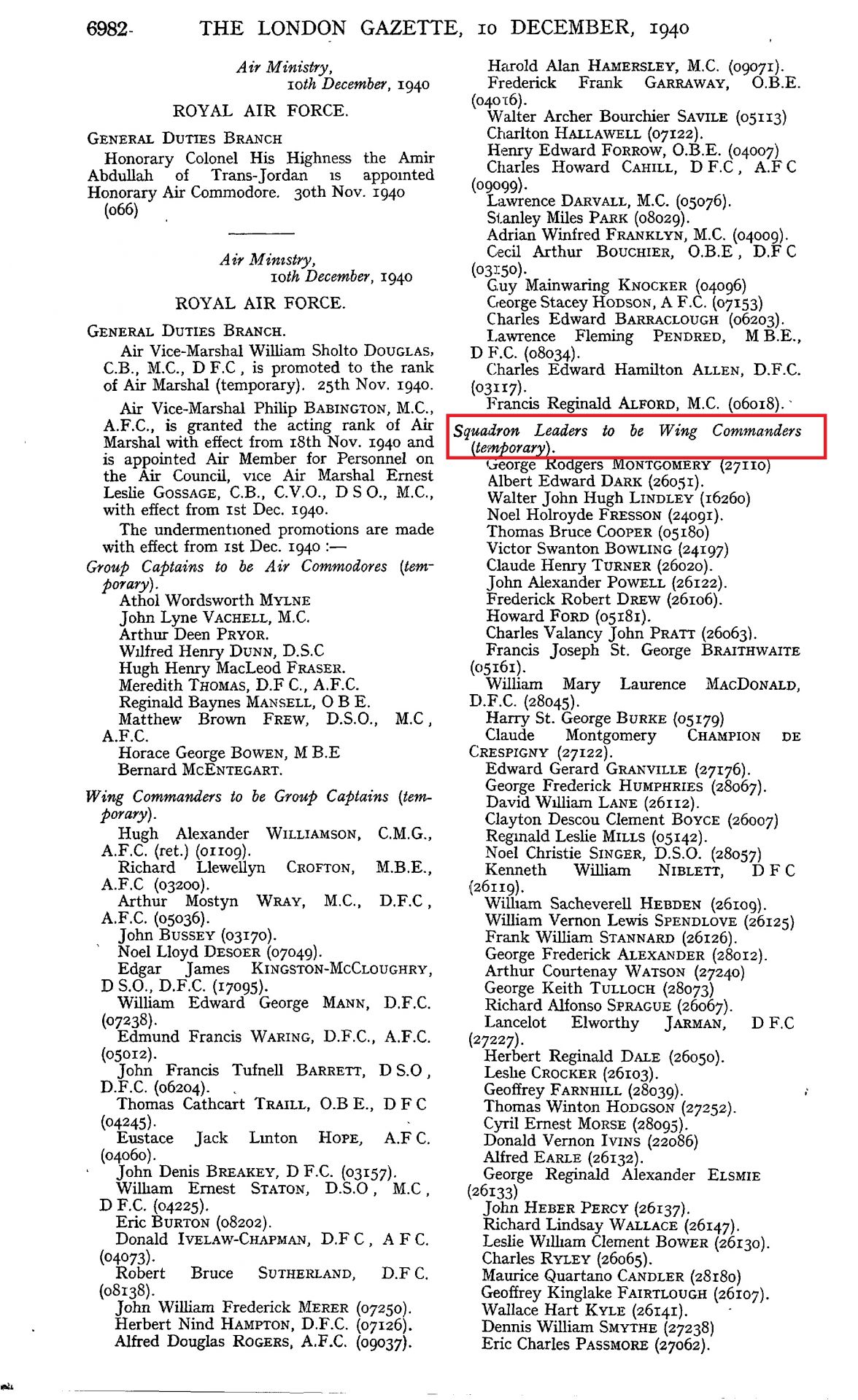
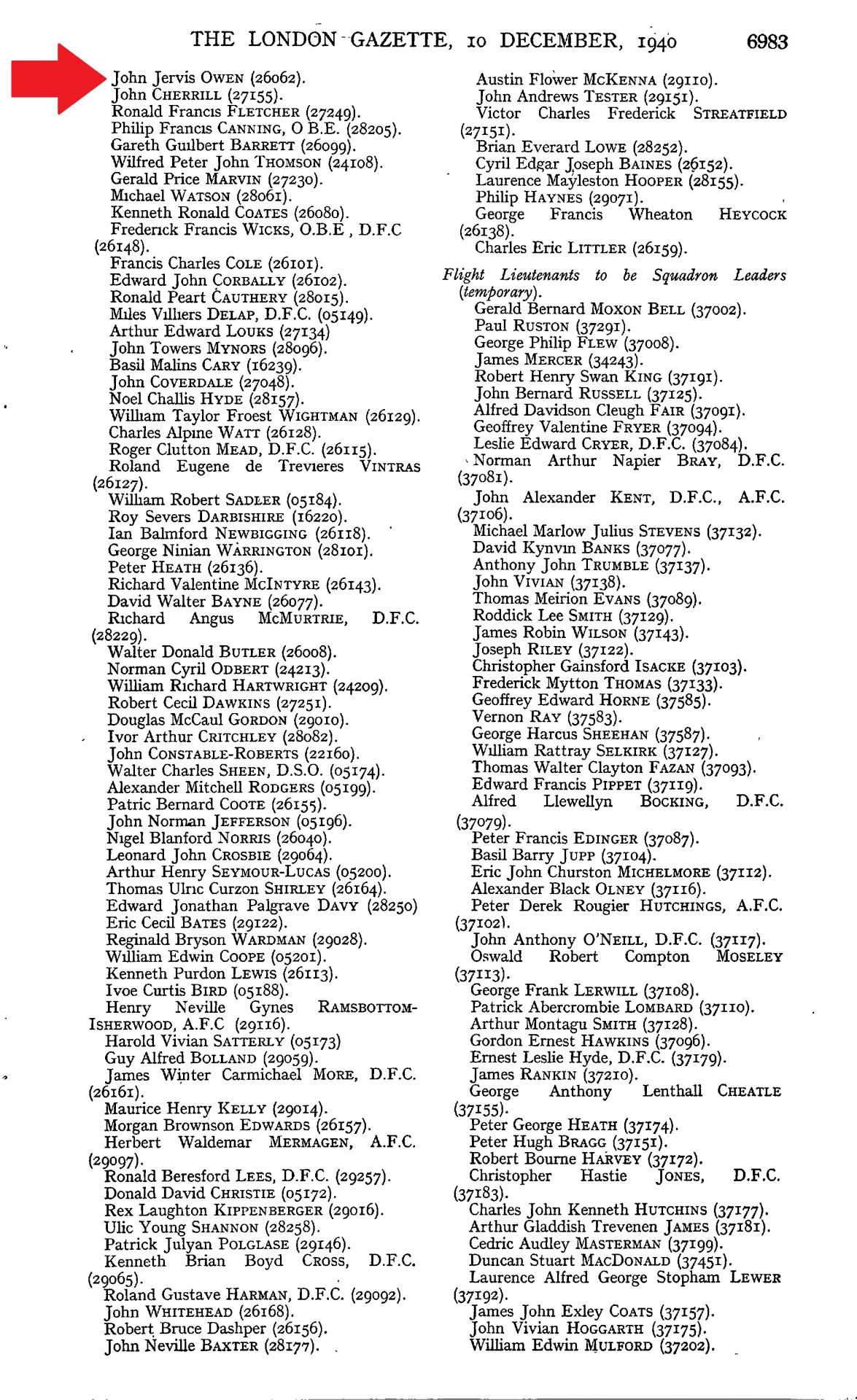
♦ " The London Gazette ", 10 December 1940 : publication of John Jervis Owen's promotion of Squadron Leader to Wing Commander (temporary) on December 1st, 1940. (
source " The Gazette ")
Ajouter un commentaire